Religious site
Dohány Street Synagogue
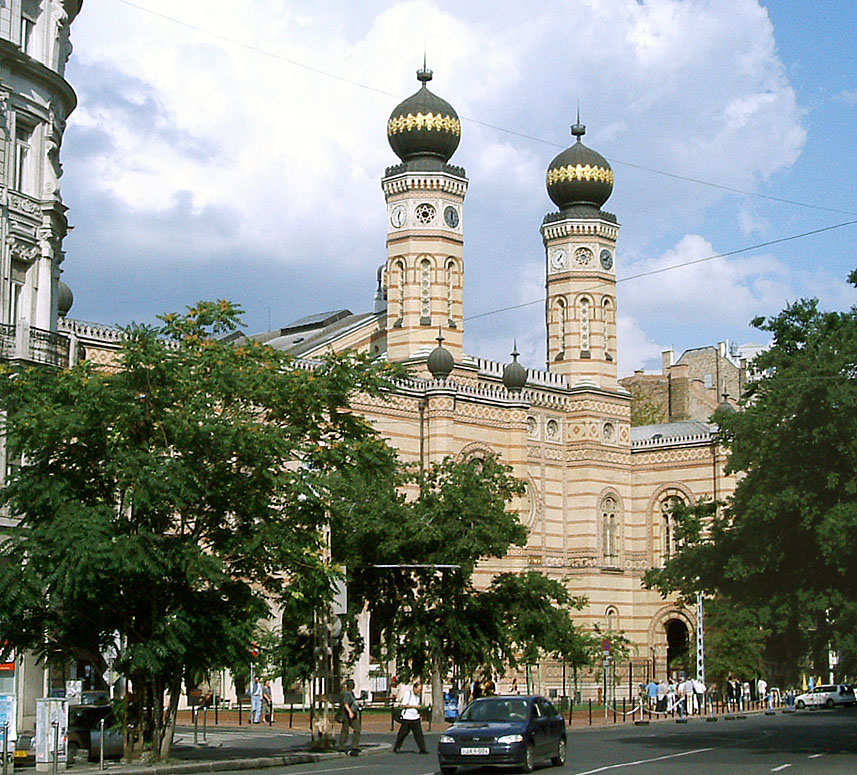 The original uploader was OsvátA at Hungarian Wikipedia. · Wikimedia Commons · CC BY-SA 3.0
Some booking links are affiliate links. If you book through them, we may earn a small commission at no extra cost to you. We never let this influence which places we recommend.
The Dohány Street Synagogue, also called the Great Synagogue, is a major Neolog Jewish synagogue in Budapest's Erzsébetváros district. The 1854–1859 complex includes the Great Synagogue, Heroes' Temple, courtyard cemetery, memorial, and Jewish museum built on the site of Theodor Herzl's birth house.
Don't miss
- Twin octagonal towers with onion domes rising 43 metres, featuring alternating yellow and red brickwork in Moorish style.
- A 5,000-pipe organ originally played by Franz Liszt and Camille Saint-Saëns; a new mechanical organ with 63 voices was installed in 1996.
- The Raoul Wallenberg Holocaust Memorial Park in the rear courtyard, with Imre Varga's weeping willow memorial inscribed with names and tattoo numbers of victims.
- The Hungarian Jewish Museum, built on Theodor Herzl's birthplace, displaying religious relics and a Holocaust room.
- The Heroes' Temple, a memorial to Hungarian Jews who died in World War I, used for weekday and winter services.
Tickets & tours
Ways to visit Dohány Street Synagogue
You can visit Dohány Street Synagogue on your own. A guide is worth it for the history and detail that is easy to walk past, and a tour can combine it with nearby sights.
 Cheapest way inWalking Tour Budapest incl. the Shoes on the Danube Bank4.9★ · 393 travelers~2 hoursFree cancellationFrom$3 per personSee dates →
 Most bookedBudapest Danube Cruise and Dinner Options, Live Music and Dance4.7★ · 7,542 travelers~2 hoursFree cancellationFrom$57 per personSee dates →
 Private & flexibleBudapest Jewish Heritage: Synagogues, Shoes, Secrets4.8★ · 59 travelers~3 hoursFree cancellationFrom$52 per personSee dates →
Getting there
Know before you go
- The synagogue stands on Dohány Street in Budapest's Jewish quarter, within the central UNESCO World Heritage area.
- The complex includes a courtyard cemetery created during the 1944–1945 ghetto.
- A pipe organ is an unusual feature for a synagogue.
A bit of history
Built between 1854 and 1859 by the Jewish community of Pest, the synagogue was designed by Viennese architect Ludwig Förster in Moorish Revival and Romantic Historicist styles, with decoration based on Islamic models from North Africa and medieval Spain. It was consecrated on 6 September 1859. During World War II, it was used as a base for German Radio and a stable for animals, suffering severe damage from air raids. Restoration began in 1991 and was completed in 1998.
Common questions
Why is there a cemetery next to the synagogue?
It is not customary to have a cemetery next to a synagogue, but this one was created out of necessity during the winter of 1944–1945 when over 2,000 people who died in the ghetto were buried in the courtyard.
What is the significance of the weeping willow memorial?
The memorial, called the Holocaust Tree of Life, is a weeping willow sculpture by Imre Varga with leaves bearing the names and tattoo numbers of victims, located in the Raoul Wallenberg Holocaust Memorial Park.
Can visitors see the original keys of the synagogue?
Yes, the keys and a silver trowel used to place the keystone in the Torah ark are kept at the adjacent Jewish Museum.
Who designed the synagogue and what style is it?
Viennese architect Ludwig Förster designed it in Moorish Revival and Romantic Historicist styles, with influences from Islamic architecture in North Africa and medieval Spain.
More attractions in Budapest