Religious site
Dohány Street Synagogue
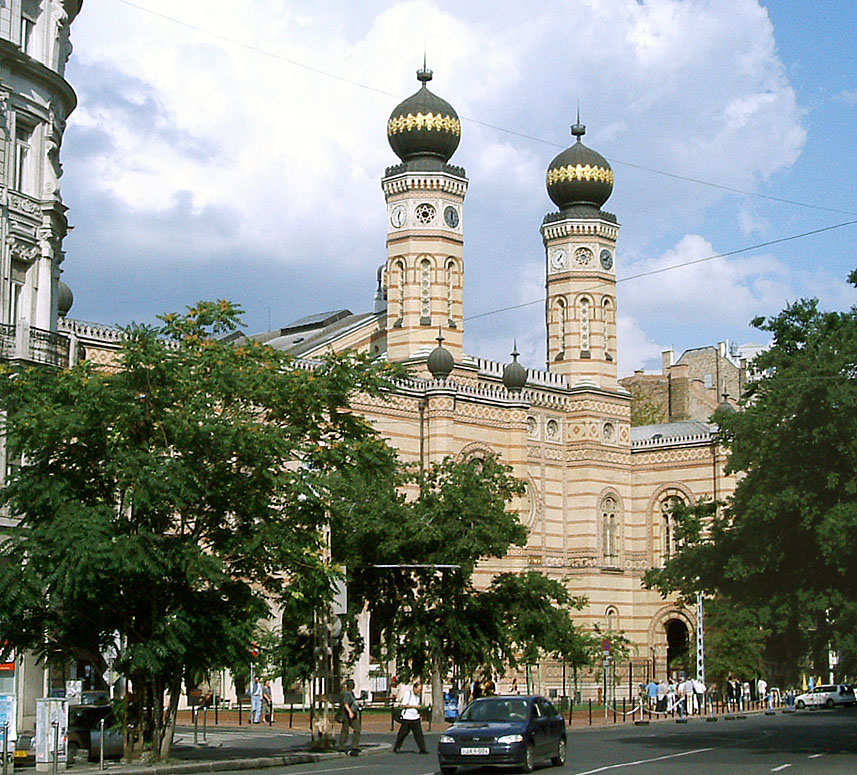 The original uploader was OsvátA at Hungarian Wikipedia. · Wikimedia Commons · CC BY-SA 3.0
Algunos enlaces de reserva son enlaces de afiliados. Si reservas a través de ellos, podríamos ganar una pequeña comisión sin coste adicional para ti. Nunca dejamos que esto influya en los lugares que recomendamos.
La Sinagoga de la Calle Dohány es la más grande de Europa y un importante sitio del patrimonio judío en Budapest. Construida en estilo neomorisco, su interior cuenta con arcos ornamentados, una gran cúpula y un órgano monumental. El complejo incluye el Museo Judío Húngaro y el Memorial del Holocausto en el patio, marcado por la impactante escultura del Árbol de la Vida. Los visitantes obtienen una visión de la historia judía y la tragedia del Holocausto a través de las exhibiciones y la atmósfera solemne de la sinagoga.
No te lo pierdas
- Admira la arquitectura neomorisca y el gran interior de la sinagoga
- Visita el Museo Judío Húngaro para ver artefactos y exhibiciones históricas
- Reflexiona en el Memorial del Holocausto con la escultura del Árbol de la Vida
Entradas y visitas guiadas
Formas de visitar Dohány Street Synagogue
Puedes visitar Dohány Street Synagogue por tu cuenta. Una guía vale la pena por la historia y los detalles que pasan desapercibidos; un tour puede combinarlo con lugares cercanos.
 Más baratoWalking Tour Budapest incl. the Shoes on the Danube Bank4.9★ · 393 viajeros~2 horasCancelación gratuitaDesde$3 por personaVer fechas →
 Más reservadoBudapest Danube Cruise and Dinner Options, Live Music and Dance4.7★ · 7542 viajeros~2 horasCancelación gratuitaDesde$57 por personaVer fechas →
 Privado y flexibleBudapest Jewish Heritage: Synagogues, Shoes, Secrets4.8★ · 59 viajeros~3 horasCancelación gratuitaDesde$52 por personaVer fechas →
Getting there
Antes de ir
- The synagogue stands on Dohány Street in Budapest's Jewish quarter, within the central UNESCO World Heritage area.
- The complex includes a courtyard cemetery created during the 1944–1945 ghetto.
- A pipe organ is an unusual feature for a synagogue.
Un poco de historia
Built between 1854 and 1859 by the Jewish community of Pest, the synagogue was designed by Viennese architect Ludwig Förster in Moorish Revival and Romantic Historicist styles, with decoration based on Islamic models from North Africa and medieval Spain. It was consecrated on 6 September 1859. During World War II, it was used as a base for German Radio and a stable for animals, suffering severe damage from air raids. Restoration began in 1991 and was completed in 1998.
Preguntas frecuentes
Why is there a cemetery next to the synagogue?
It is not customary to have a cemetery next to a synagogue, but this one was created out of necessity during the winter of 1944–1945 when over 2,000 people who died in the ghetto were buried in the courtyard.
What is the significance of the weeping willow memorial?
The memorial, called the Holocaust Tree of Life, is a weeping willow sculpture by Imre Varga with leaves bearing the names and tattoo numbers of victims, located in the Raoul Wallenberg Holocaust Memorial Park.
Can visitors see the original keys of the synagogue?
Yes, the keys and a silver trowel used to place the keystone in the Torah ark are kept at the adjacent Jewish Museum.
Who designed the synagogue and what style is it?
Viennese architect Ludwig Förster designed it in Moorish Revival and Romantic Historicist styles, with influences from Islamic architecture in North Africa and medieval Spain.
Más atracciones en Budapest