Landmark
Hungarian Parliament Building
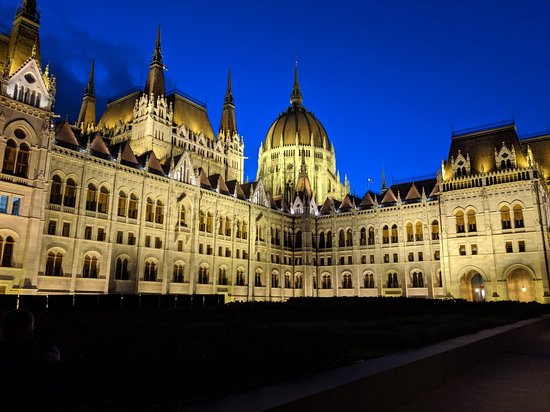 Photo via TripAdvisor (DamonWP)
Some booking links are affiliate links. If you book through them, we may earn a small commission at no extra cost to you. We never let this influence which places we recommend.
The Hungarian Parliament Building stands on Kossuth Square on the Pest bank of the Danube and serves as the seat of Hungary's National Assembly. Architect Imre Steindl designed it in a Gothic Revival style influenced by London's Palace of Westminster and Vienna's Gothic city hall, while the central dome uses Renaissance Revival forms. The Danube façade is symmetrical, and the interior repeats that balance with two matching parliamentary chambers on opposite sides of a sixteen-sided central hall. Hungary's modern unicameral National Assembly meets in the former Lower House chamber; the other hall is used for ceremonies, conferences, and guided visits. The building is 268 metres long, 123 metres wide, and 96 metres high. That height refers to the traditional date of 896 for the Hungarian conquest of the Carpathian Basin and to the millennium celebrated in 1896. Its scale includes ten courtyards, twenty-seven gates, twenty-nine staircases, and 691 rooms. The exterior and interior contain 242 sculptures, with Hungarian rulers, Transylvanian leaders, military figures, Árpád, Stephen I, and John Hunyadi among those represented. Visitors entering from the east side encounter ornamental stairs, ceiling frescoes, stained glass and glass mosaics by Miksa Róth, and Steindl's bust. The Holy Crown of Hungary has been displayed in the central hall since 2000, making the building both a functioning legislature and a setting for national symbols.
Don't miss
- The sixteen-sided central hall displaying the Holy Crown of Hungary
- Two symmetrical parliamentary chambers, one active and one used for ceremonies and tours
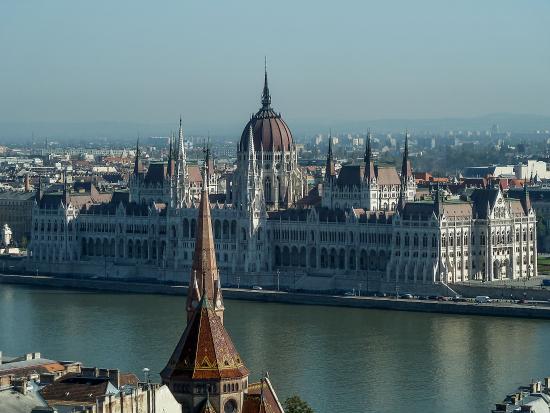
- The Danube-facing Gothic Revival façade and Renaissance Revival dome
- Ornamental staircases, frescoed ceilings, and stained glass by Miksa Róth
- Sculptures of Hungarian rulers, leaders, and military figures inside and outside
- The main Gothic Revival façade overlooking the Danube
Tickets & tours
Ways to visit Hungarian Parliament Building
You can see Hungarian Parliament Building on your own. A tour is worth it for the story behind it, for transport, or for combining nearby sights into one day.
 Cheapest way inBudapest free walking tour: Parliament and Shoes Memorial5★ · 504 travelers~2 hoursFree cancellationFrom$3 per personSee dates →
 Most bookedBudapest Historical Sightseeing - Free Walking Tour4.8★ · 1,491 travelers~3 hoursFree cancellationFrom$3 per personSee dates →
 Private & flexible1 Hour Budapest Segway Tour - Parliament Hightails5★ · 203 travelers~1 hourFree cancellationFrom$45 per personSee dates →
Getting there
Know before you go
- The grand façade faces the Danube, but the official main entrance is on the east side from Kossuth Square.
- The Holy Crown of Hungary has been displayed in the central hall since 2000.
- One chamber remains in legislative use; the matching former Upper House chamber supports ceremonies, conferences, and guided tours.
- Kossuth Lajos Square is served by Budapest Metro Line 2 and tram line 2.
A bit of history
Budapest was formed by uniting Buda, Óbuda, and Pest in 1873. Seven years later, the Hungarian Diet decided that the new capital needed a representative parliament building facing the Danube and expressing national sovereignty. An international competition selected Steindl's proposal. The plans of two other competitors were later realized as the Ethnographic Museum and the Hungarian Ministry of Agriculture, both facing the Parliament Building. The resemblance of Steindl's design to the Palace of Westminster reflected the importance nineteenth-century Hungarian reformers placed on Britain as a political model and on Hungary's commitment to Western Europe. Construction began in 1885. The building was inaugurated during the 1896 celebration of the country's presumed thousandth anniversary, although the keys were not handed over until 1902 and work continued until 1904. The project consumed forty million bricks, half a million precious stones, and forty kilograms of gold. Steindl went blind and died before completion. After the Second World War, Hungary's legislature became unicameral, leaving the paired halls with different functions. During the communist People's Republic, a red star stood above the dome. It was removed in 1990 after the end of communist rule. On 23 October 1989, Mátyás Szűrös declared the Hungarian Republic from the balcony facing Kossuth Square.
Common questions
Who designed the Hungarian Parliament Building?
Hungarian architect Imre Steindl won the international competition with a Gothic Revival design.
When was it completed?
Construction began in 1885, the building was inaugurated in 1896, keys were handed over in 1902, and work was fully complete in 1904.
Why is the dome 96 metres high?
The height refers to the millennium celebrated in 1896 and the traditional year 896 for the Hungarian conquest of the Carpathian Basin.
How are the two parliamentary chambers used?
The modern National Assembly meets in the Lower House, while the other matching hall is used for ceremonies, conferences, and guided tours.
What is displayed in the central hall?
The Holy Crown of Hungary has been kept there since 2000, beneath the building's sixteen-sided central dome.
More attractions in Budapest