Museum
Musée d'Orsay
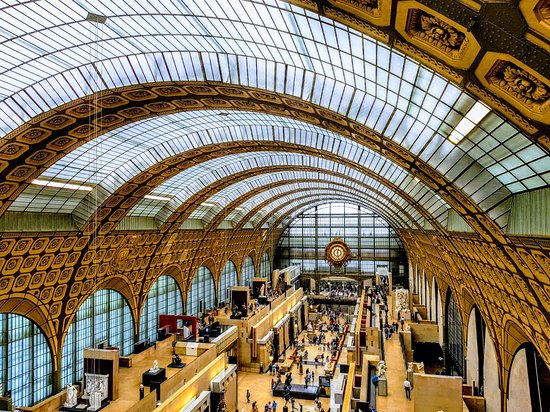 Photo via TripAdvisor (Brainstormpig17)
Some booking links are affiliate links. If you book through them, we may earn a small commission at no extra cost to you. We never let this influence which places we recommend.
The Musée d'Orsay is a Paris art museum on the Left Bank of the Seine, housed in the former Gare d'Orsay railway station. Its collections focus mainly on French art, including work by foreign artists active in France, from 1848 to 1914. That period places the museum between the older collections of the Louvre and the modern art represented by the Centre Pompidou. Paintings, sculpture, furniture, photography, architecture, and decorative art share the building, with the world's largest group of Impressionist and Post-Impressionist masterpieces at its core. Artists represented include Berthe Morisot, Claude Monet, Édouard Manet, Edgar Degas, Pierre-Auguste Renoir, Paul Cézanne, Georges Seurat, Alfred Sisley, Paul Gauguin, and Vincent van Gogh. The station itself is one of the museum's major works. Built from 1898 to 1900 for the Paris to Orléans railway and completed for the 1900 Exposition Universelle, its Beaux-Arts shell concealed the modern functions of a rail terminal. Gae Aulenti's museum interior preserves the great barrel-vaulted space and turns the former platforms into a central nave organized by stone structures. Around 3,000 works are displayed at a time. A glass-covered 1:100 model of the Paris Opera district lets visitors walk above a detailed view of the city, connecting the collection to the urban and architectural transformation of nineteenth-century Paris.
Don't miss
- The former Gare d'Orsay's barrel-vaulted atrium and central nave
- Impressionist and Post-Impressionist works by Monet, Manet, Degas, Renoir, Cézanne, Gauguin, and van Gogh
- Sculpture displayed along the central nave formed from the old train platforms
- The glass-covered 1:100 model of the Paris Opera district
- Furniture, photography, architecture, and decorative art from 1848 to 1914
- Six bronze allegorical continent groups outside, made for the 1900 Exposition Universelle
Tickets & tours
Ways to visit Musée d'Orsay
You can visit Musée d'Orsay on your own. A guide mainly adds context, what you are looking at and why it matters, and a tour can add transport or combine nearby sights into one day.
 Cheapest way inParis: Orsay Museum Daily Entry Ticket4.3★ · 832 travelers2-4 hoursFree cancellationFrom$23 per personSee dates →
 Most bookedParis: Musée d’Orsay Skip-the-Line Tour with Expert Guide4.7★ · 1,196 travelers~2 hoursFree cancellationFrom$81 per personSee dates →
 Private & flexibleOrsay Museum Premium Guided Tour 6 GUESTS MAX with Entry Included4.9★ · 625 travelers2-3 hoursFree cancellationFrom$73 per personSee dates →
Getting there
Know before you go
- The collection concentrates on the period from 1848 to 1914 and links the Louvre's chronology with the Centre Pompidou's modern holdings.
- The museum occupies a former railway station completed for the 1900 Exposition Universelle.
- The station architecture is integral to the visit, especially the central nave created from the old platforms.
- About 3,000 works are displayed at a time across paintings, sculpture, furniture, photography, and other media.
A bit of history
The Gare d'Orsay was designed by Lucien Magne, Émile Bénard, and Victor Laloux and opened for the 1900 Exposition Universelle. Its central position made it convenient for travelers, but changing railway technology eventually made the old terminal unsuitable for long-distance trains. During the 1970s, a new underground station for RER line C was constructed beneath it. Demolition was authorized in 1970, but Culture Minister Jacques Duhamel opposed replacing the station with a hotel. The building entered the supplementary register of Historic Monuments and received full listing in 1978. French museum officials proposed adapting it into a museum that would bridge the chronological gap between the Louvre and the National Museum of Modern Art. ACT Architecture, the team of Pierre Colboc, Renaud Bardon, and Jean-Paul Philippon, won the conversion contract and inserted new floors while respecting the station's vast interior. Italian architect Gae Aulenti designed the internal arrangement, decoration, furniture, and fittings. The museum was ready for installation in July 1986; approximately 2,000 paintings, 600 sculptures, and other works were placed over six months. President François Mitterrand formally opened it in December 1986. The conversion saved a major railway monument while giving art from 1848 to 1914 a setting built during the same era.
Common questions
What period does the Musée d'Orsay cover?
Its main focus is art from 1848 to 1914, including painting, sculpture, furniture, photography, architecture, and decorative arts.
Was the building originally a station?
Yes. Gare d'Orsay was built from 1898 to 1900 for the Paris to Orléans railway and the 1900 Exposition Universelle.
Why was the station not demolished?
Culture Minister Jacques Duhamel opposed a replacement hotel, and the station was eventually protected as a Historic Monument before conversion into a museum.
When did the museum open?
After a major architectural conversion and six months of installation, it officially opened in December 1986.
Which artists are strongly represented?
The collections include major works by Morisot, Monet, Manet, Degas, Renoir, Cézanne, Seurat, Gauguin, and van Gogh, among many others.
More attractions in Paris