Landmark
Bronze Horseman
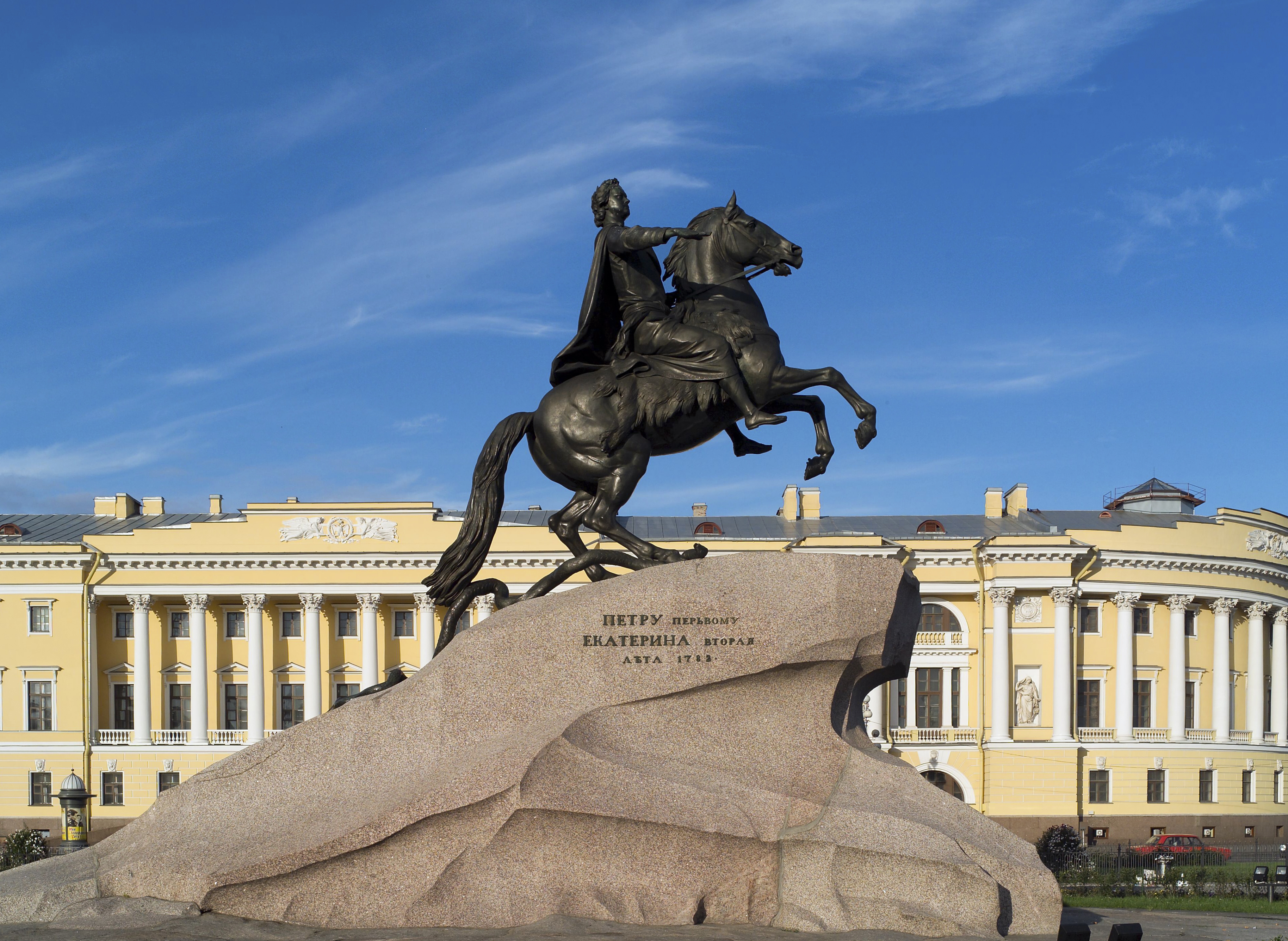 Godot13 · Wikimedia Commons · CC BY-SA 3.0
部分预订链接为联盟链接。通过它们预订,我们可能获得小额佣金,但不会增加你的费用。我们绝不会因此影响推荐。
The Bronze Horseman is an equestrian statue of Peter the Great in Senate Square, Saint Petersburg. It was commissioned by Catherine the Great and created by French sculptor Étienne Maurice Falconet. The statue shows Peter the Great on a rearing horse, his arm pointing toward the River Neva, with a serpent being trampled under the horse's hooves. It is one of the symbols of Saint Petersburg.
不容错过
- The statue is about 6 metres (20 ft) tall, with a pedestal of about 7 metres (23 ft), for a total of approximately 13 metres (43 ft).
- The pedestal is the Thunder Stone, a granite monolith that originally weighed about 1,500 tonnes and was carved down to 1,250 tons during transport.
- The horse tramples a serpent, which is interpreted to represent treachery, evil, or the enemies of Peter the Great and his reforms.
- The tsar's face was modeled by Marie-Anne Collot, then only 18 years old, using Peter the Great's death mask and portraits.
- The statue's right hand was modeled from a Roman bronze hand found in 1771 in the Netherlands.
- The statue inspired Alexander Pushkin's 1833 poem 'The Bronze Horseman,' which is considered one of the most significant works of Russian literature.
门票与行程
游览Bronze Horseman的方式
你可以自行参观Bronze Horseman。参加行程适合了解背后的故事、需要交通,或想一天内结合附近景点的情况。
 最省钱St. Petersburg Jungle Prada Site History Tour5★ · 630位游客约2小时免费取消起价$18 每人查看日期 →
 最受欢迎Saint Petersburg Historic Segway Tour4.9★ · 164位游客约2小时免费取消起价$70 每人查看日期 →
 私享灵活Private Golf Cart Tour - The History of St. Petersburg5★ · 13位游客约2小时免费取消起价$49 每人查看日期 →
如何到达
行前须知
- The statue is located in Senate Square (formerly Decembrists Square), in Saint Petersburg.
- The statue is inscribed in Latin and Russian: 'Catherine the Second to Peter the First, 1782'.
- A 19th-century legend says that as long as the statue stands, enemy forces cannot conquer the city.
历史背景
Catherine the Great, who had no legal claim to the throne, commissioned the statue to connect herself to Peter the Great and gain legitimacy. The statue was unveiled on 7 August 1782, fourteen years after excavation of the pedestal began. Falconet was forced to leave Russia four years before the project was completed due to a conflict with the empress. The statue's pedestal is the Thunder Stone, a rapakivi granite monolith that is the largest stone ever moved by humans. It was found at Lakhta, 6 km inland from the Gulf of Finland, and moved using a metallic sled over bronze spheres, a process similar to ball bearings. The labor was done entirely by humans; no animals or machines were used. During the Siege of Leningrad in World War II, the statue was covered with sandbags and a wooden shelter and survived 900 days of bombing and artillery fire virtually untouched.
常见问题
Why is it called the Bronze Horseman?
The name comes from Alexander Pushkin's 1833 poem of the same name, which is widely considered one of the most significant works of Russian literature. The poem's popularity led to the statue being called the 'Bronze Horseman'.
How was the pedestal moved?
The Thunder Stone was moved using a metallic sled that slid over bronze spheres, similar to ball bearings. It took 400 men nine months to move the stone, and the labor was done entirely by humans; no animals or machines were used.
What happened to the statue during World War II?
During the 900-day Siege of Leningrad, the statue was covered with sandbags and a wooden shelter. It survived the bombing and artillery fire virtually untouched.
Saint Petersburg更多景点