Landmark
Bronze Horseman
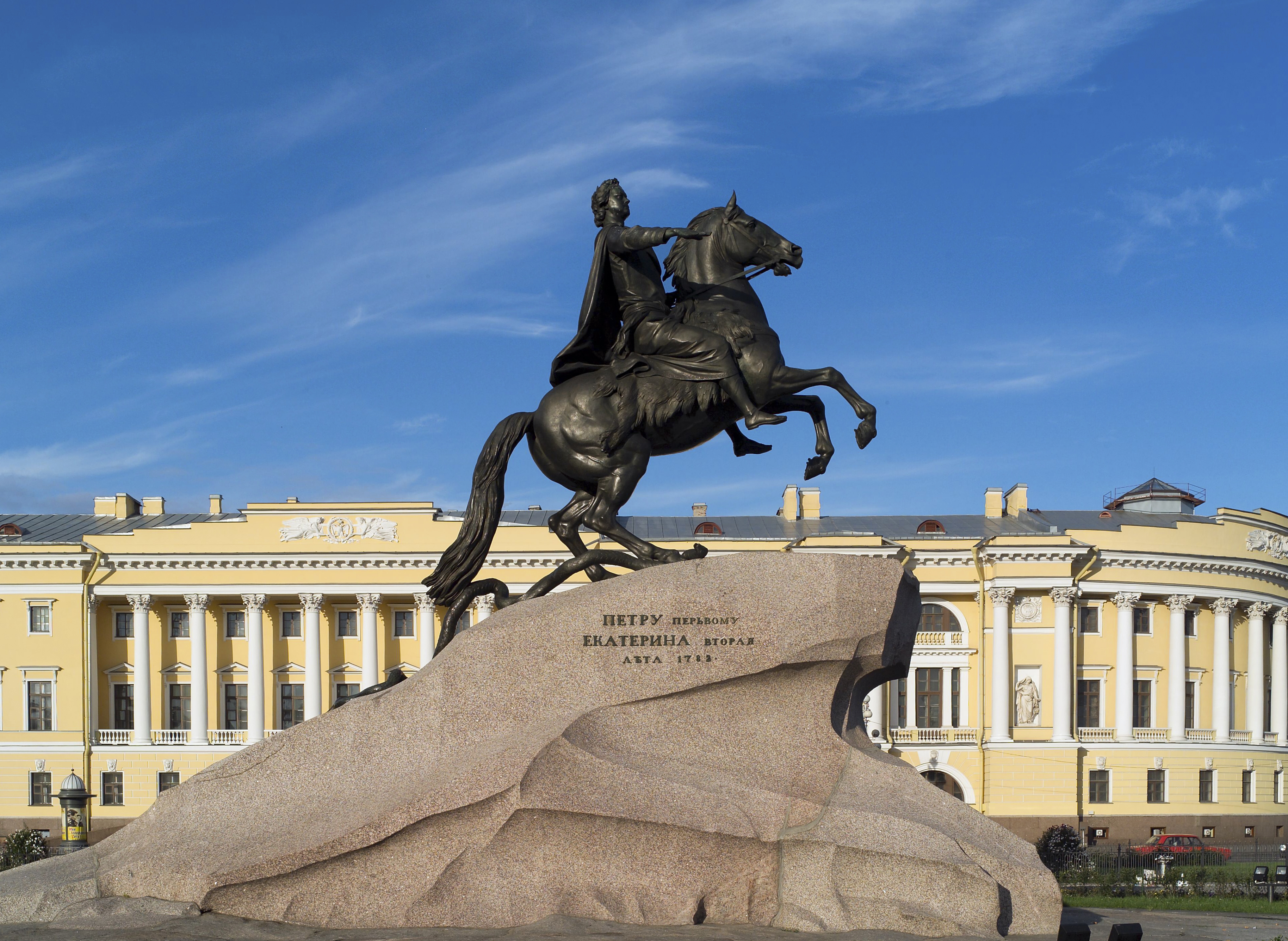 Godot13 · Wikimedia Commons · CC BY-SA 3.0
Some booking links are affiliate links. If you book through them, we may earn a small commission at no extra cost to you. We never let this influence which places we recommend.
The Bronze Horseman is an equestrian statue of Peter the Great in Senate Square, Saint Petersburg. It was commissioned by Catherine the Great and created by French sculptor Étienne Maurice Falconet. The statue shows Peter the Great on a rearing horse, his arm pointing toward the River Neva, with a serpent being trampled under the horse's hooves. It is one of the symbols of Saint Petersburg.
Don't miss
- The statue is about 6 metres (20 ft) tall, with a pedestal of about 7 metres (23 ft), for a total of approximately 13 metres (43 ft).
- The pedestal is the Thunder Stone, a granite monolith that originally weighed about 1,500 tonnes and was carved down to 1,250 tons during transport.
- The horse tramples a serpent, which is interpreted to represent treachery, evil, or the enemies of Peter the Great and his reforms.
- The tsar's face was modeled by Marie-Anne Collot, then only 18 years old, using Peter the Great's death mask and portraits.
- The statue's right hand was modeled from a Roman bronze hand found in 1771 in the Netherlands.
- The statue inspired Alexander Pushkin's 1833 poem 'The Bronze Horseman,' which is considered one of the most significant works of Russian literature.
Tickets & tours
Ways to visit Bronze Horseman
You can see Bronze Horseman on your own. A tour is worth it for the story behind it, for transport, or for combining nearby sights into one day.
 Cheapest way inSt. Petersburg Jungle Prada Site History Tour5★ · 628 travelers~2 hoursFree cancellationFrom$18 per personSee dates →
 Most bookedSaint Petersburg Historic Segway Tour4.9★ · 164 travelers~2 hoursFree cancellationFrom$70 per personSee dates →
 Private & flexiblePrivate Golf Cart Tour - The History of St. Petersburg5★ · 13 travelers~2 hoursFree cancellationFrom$49 per personSee dates →
Getting there
Know before you go
- The statue is located in Senate Square (formerly Decembrists Square), in Saint Petersburg.
- The statue is inscribed in Latin and Russian: 'Catherine the Second to Peter the First, 1782'.
- A 19th-century legend says that as long as the statue stands, enemy forces cannot conquer the city.
A bit of history
Catherine the Great, who had no legal claim to the throne, commissioned the statue to connect herself to Peter the Great and gain legitimacy. The statue was unveiled on 7 August 1782, fourteen years after excavation of the pedestal began. Falconet was forced to leave Russia four years before the project was completed due to a conflict with the empress. The statue's pedestal is the Thunder Stone, a rapakivi granite monolith that is the largest stone ever moved by humans. It was found at Lakhta, 6 km inland from the Gulf of Finland, and moved using a metallic sled over bronze spheres, a process similar to ball bearings. The labor was done entirely by humans; no animals or machines were used. During the Siege of Leningrad in World War II, the statue was covered with sandbags and a wooden shelter and survived 900 days of bombing and artillery fire virtually untouched.
Common questions
Why is it called the Bronze Horseman?
The name comes from Alexander Pushkin's 1833 poem of the same name, which is widely considered one of the most significant works of Russian literature. The poem's popularity led to the statue being called the 'Bronze Horseman'.
How was the pedestal moved?
The Thunder Stone was moved using a metallic sled that slid over bronze spheres, similar to ball bearings. It took 400 men nine months to move the stone, and the labor was done entirely by humans; no animals or machines were used.
What happened to the statue during World War II?
During the 900-day Siege of Leningrad, the statue was covered with sandbags and a wooden shelter. It survived the bombing and artillery fire virtually untouched.
More attractions in Saint Petersburg