Landmark
Victor Emmanuel II Monument
 Max_Ryazanov · Wikimedia Commons · CC BY-SA 3.0
Some booking links are affiliate links. If you book through them, we may earn a small commission at no extra cost to you. We never let this influence which places we recommend.
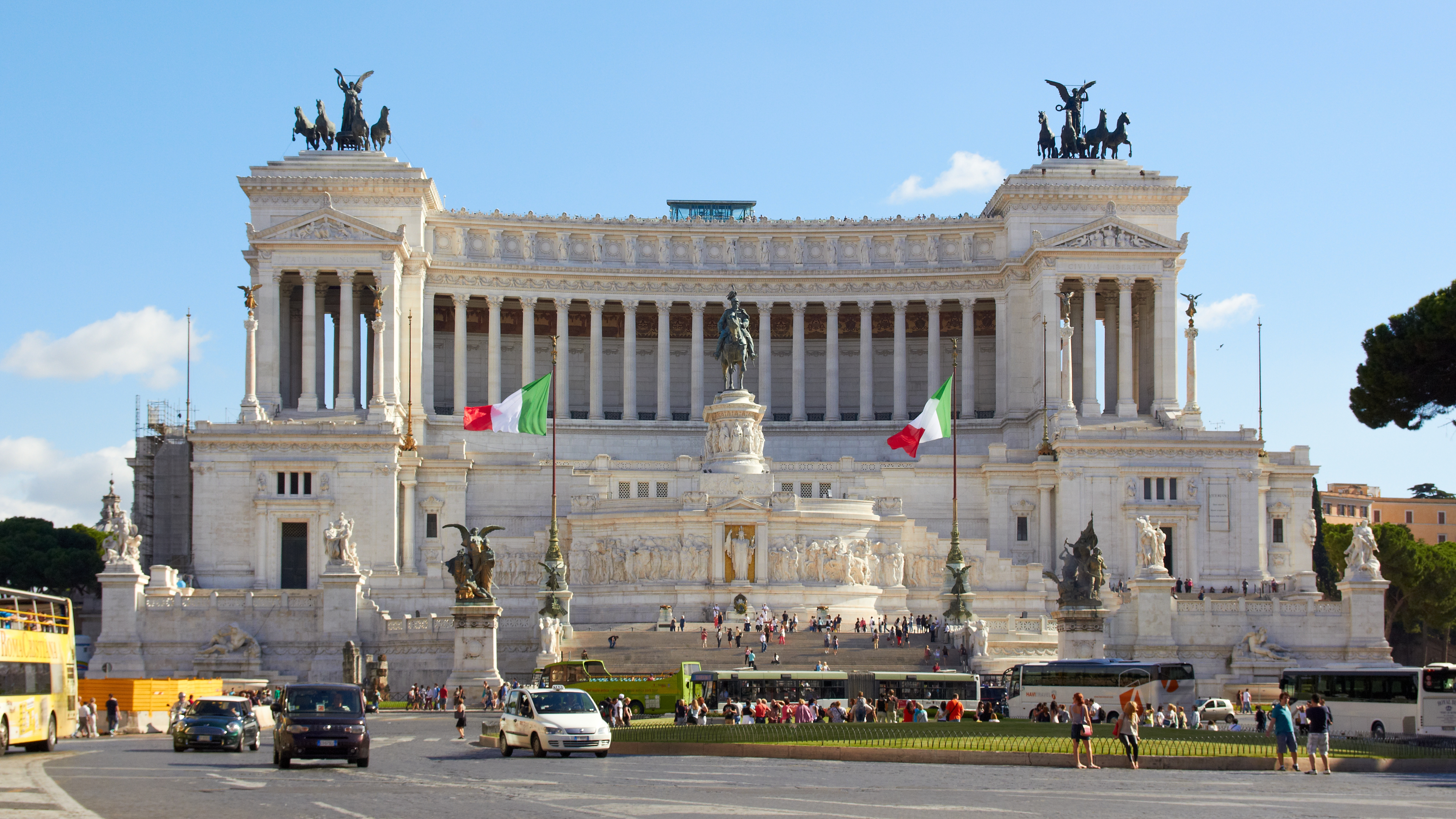
The Victor Emmanuel II National Monument, also called the Vittoriano or Altare della Patria, is a large marble monument on the Capitoline Hill in central Rome. It was built between 1885 and 1935 to honor Victor Emmanuel II, the first king of a unified Italy. You see a neoclassical structure with stairways, Corinthian columns, fountains, an equestrian statue of the king, and two statues of the goddess Victoria riding chariots. A lift takes you to the roof for 360-degree views of Rome.
Don't miss
- The equestrian statue of Victor Emmanuel II, the architectural center of the monument
- The Altar of the Fatherland, with a large statue of the goddess Roma
- The Tomb of the Italian Unknown Soldier, with an eternal flame
- Two statues of the goddess Victoria riding quadrigas (four-horse chariots) on the top
- The roof terrace, reachable by lift or 196 steps, offering 360-degree views of Rome
- The colonnade with 15-meter-high Corinthian columns
Tickets & tours
Ways to visit Victor Emmanuel II Monument
You can see Victor Emmanuel II Monument on your own. A tour is worth it for the story behind it, for transport, or for combining nearby sights into one day.
 Cheapest way inColosseum and Roman Forum Sightseeing Area Walking Tour4.8★ · 175 travelers~2 hoursFree cancellationFrom$5 per personSee dates →
 Most bookedRome After Dark: Explore the Eternal City Under the Moonlight5★ · 737 travelers~2 hoursFree cancellationFrom$338 per personSee dates →
 Top ratedRome City, Pantheon, and Trevi Fountain Walking Tour4.9★ · 405 travelers~2 hoursFree cancellationFrom$23 per personSee dates →
Know before you go
- The monument is on the Capitoline Hill, between Piazza Venezia and the Capitoline Hill.
- There are 243 steps in total across the external staircases.
- A lift goes to the roof terrace for 360-degree views of Rome.
- Major national celebrations like Liberation Day (25 April) and Republic Day (2 June) are held here.
A bit of history
After Victor Emmanuel II died in 1878, the Italian government approved a monument on the northern slope of the Capitoline Hill. Architect Giuseppe Sacconi designed it in an eclectic style inspired by Hellenistic sanctuaries. Construction required demolishing medieval buildings in the historic center. The partly finished monument was inaugurated on 4 June 1911, the 50th anniversary of Italian unification. In 1921 the body of the Italian Unknown Soldier was placed under the statue of the goddess Roma. The monument was fully completed in 1935.
Common questions
What is the Altare della Patria?
It is the altar of the goddess Roma, located on the first terrace after the entrance. It also became a shrine for the Italian Unknown Soldier. The whole monument is often called the Altare della Patria, but that name refers only to this part.
Who is buried in the monument?
The Tomb of the Italian Unknown Soldier holds the body of an unidentified Italian soldier who died in World War I. It represents all Italian soldiers who died in wars.
Can I go to the top of the monument?
Yes. A lift added in 2007 takes you to the roof for 360-degree views of Rome. You can also climb 196 steps from the portico.
What style is the monument built in?
It is neoclassical, inspired by the Roman Forum and Hellenistic sanctuaries like the Pergamon Altar.
More attractions in Rome