Religious site
Santa Maria sopra Minerva
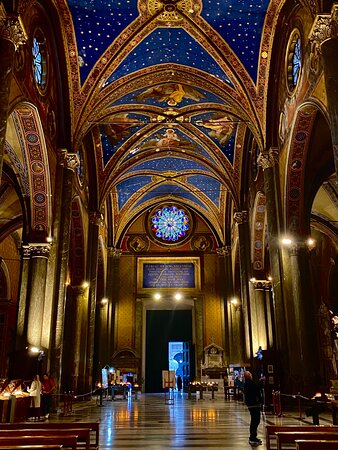 Photo via TripAdvisor (dapper777)
Some booking links are affiliate links. If you book through them, we may earn a small commission at no extra cost to you. We never let this influence which places we recommend.
Santa Maria sopra Minerva is a minor basilica and one of the major Dominican churches in Rome. It is the only surviving example of original Gothic architecture in the city, with a restrained Renaissance façade and a Gothic interior featuring blue vaulted ceilings with gilded stars and red ribbing. The church stands in Piazza della Minerva, one block east of the Pantheon.
Don't miss
- Michelangelo's marble sculpture Cristo della Minerva (1521), located left of the main altar
- Late 15th-century frescoes by Filippino Lippi in the Carafa Chapel, including the Annunciation and the Glory of St Thomas
- Tombs of Saint Catherine of Siena and the Dominican friar Fra Angelico
- Ornate funerary monuments to Medici popes Leo X and Clement VII, designed by Baccio Bandinelli
- Gothic interior with blue vaulted ceiling painted with gilded stars and red ribbing, restored in the 19th century
- Marks on the façade indicating flood levels of the Tiber from the 16th and 17th centuries
Tickets & tours
Ways to visit Santa Maria sopra Minerva
You can visit Santa Maria sopra Minerva on your own. A guide is worth it for the history and detail that is easy to walk past, and a tour can combine it with nearby sights.
 Cheapest way inRome City, Pantheon, and Trevi Fountain Walking Tour4.9★ · 407 travelers~2 hoursFree cancellationFrom$23 per personSee dates →
 Most bookedPantheon, The Best-Preserved Roman Monument Guided Tour4.4★ · 176 travelers~1 hourFree cancellationFrom$41 per personSee dates →
 Private & flexibleRome to Fiumicino Airport Rome (FCO) - Departure Private Transfer4.6★ · 10 travelers~1 hourFree cancellationFrom$49 per personSee dates →
Know before you go
- The church is located in Piazza della Minerva, one block east of the Pantheon in the Pigna district.
- It is a minor basilica and a titular church since 1557.
A bit of history
The church was built directly over the ruins of a temple dedicated to the Egyptian goddess Isis, later mistakenly attributed to Minerva. In 1255 Pope Alexander IV established a community on the site, and by 1275 the Dominicans took possession. Construction of the present Gothic church began in 1280, modeled on Santa Maria Novella in Florence. The interior was completed in 1453, and the façade was finished in 1725. The church hosted papal conclaves in 1431 and 1447. In 1633, Galileo Galilei abjured his scientific theses in a room of the adjacent convent, then the seat of the Roman Inquisition.
Common questions
What is the significance of the church's name?
The name means 'Saint Mary above Minerva,' referring to the first Christian church built directly over the ruins of a temple originally dedicated to the Egyptian goddess Isis, later mistakenly attributed to the Roman goddess Minerva.
Is Santa Maria sopra Minerva the only Gothic church in Rome?
Yes, it is the only extant example of original Gothic architecture church building in Rome.
What famous works of art are inside the church?
Notable works include Michelangelo's marble sculpture Cristo della Minerva, Filippino Lippi's frescoes in the Carafa Chapel, and tombs of Saint Catherine of Siena and Fra Angelico.
What historical event involving Galileo took place here?
On 22 June 1633, Galileo Galilei abjured his Copernican theses in a room of the convent, which then served as the seat of the Roman Inquisition.
More attractions in Rome