Religious site
Matthias Church
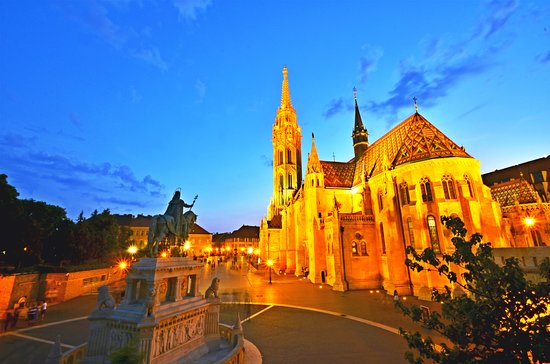 Photo via TripAdvisor (fanfancatTW)
Some booking links are affiliate links. If you book through them, we may earn a small commission at no extra cost to you. We never let this influence which places we recommend.
Matthias Church, officially the Church of the Assumption of the Buda Castle, is a Catholic church on Holy Trinity Square in Budapest's Castle District, directly in front of the Fisherman's Bastion. It was originally built in the 13th century and later rebuilt in a florid late Gothic style. The church served as the coronation site for the last two Hungarian kings, Franz Joseph I and Charles IV.
Don't miss
- The diamond-patterned roof tiles and gargoyle-laden spire added during Schulek's 19th-century restoration.
- The neo-Gothic pulpit (1890-1893) with statues of the four evangelists and four Latin doctors of the church.
- The Maria Gate at the southwest, a rare original medieval feature from the early 15th century depicting the Virgin Mary falling asleep.
- The Loreto Chapel beneath the southern tower, which preserves a Madonna statue from the late 17th century.
- The Ecclesiastical Art Museum in the medieval crypt and St. Stephen Chapel, displaying sacred relics and replicas of the Hungarian royal crown and coronation jewels.
Tickets & tours
Ways to visit Matthias Church
You can visit Matthias Church on your own. A guide is worth it for the history and detail that is easy to walk past, and a tour can combine it with nearby sights.
 Cheapest way inBudapest Castle District Walking Tour4.9★ · 657 travelers~2 hoursFree cancellationFrom$3 per personSee dates →
 Most bookedBudapest Private Tuk Tuk Half-Day Tour4.9★ · 671 travelers~4 hoursFree cancellationFrom$172 per personSee dates →
 Private & flexibleCastle District tour with Matthias Church Ticket & Cake & Coffee5★ · 33 travelers~3 hoursFree cancellationFrom$122 per personSee dates →
Getting there
Know before you go
- The church is located on Holy Trinity Square, directly in front of the Fisherman's Bastion in Buda's Castle District.
- It was the coronation church for Franz Joseph I in 1867 and Charles IV in 1916.
- The interior decoration, including figurative murals and stained glass, was directed by Bertalan Székely and Károly Lotz.
- The church has seven bells; three are historic (from 1723, 1724, and 1891), and four were added in 2010.
A bit of history
According to tradition, the first church on this site was founded by Saint Stephen in 1015, though clear evidence is lacking. The current building was constructed after the Mongol invasion, between 1255 and 1269, under King Béla IV. During the Ottoman occupation from 1541 to 1686, it was converted into the main mosque of Buda. In 1686, during the siege of Buda, a wall collapsed to reveal a hidden Madonna statue, an event known as the 'Marian Miracle' that contemporaries credited with the city's fall. The church underwent a major neo-Gothic restoration by architect Frigyes Schulek from 1874 to 1896.
Common questions
Why is it called Matthias Church?
It has been referred to as Matthias Church since the 19th century, after King Matthias Corvinus, who ordered the transformation of its original southern tower.
What is the 'Marian Miracle' of Buda?
In 1686, during the siege of Buda, a wall of the church (then used as a mosque) collapsed due to cannon fire, revealing a hidden votive Madonna statue. The appearance of the statue reportedly caused the Muslim garrison's morale to collapse, and the city fell the same day.
What coronations took place here?
The last two Hungarian kings were crowned here: Franz Joseph I in 1867 and Charles IV in 1916.
What can I see in the church museum?
The Ecclesiastical Art Museum, located in the medieval crypt and St. Stephen Chapel, contains sacred relics, medieval stone carvings, and replicas of the Hungarian royal crown and coronation jewels.
What is the significance of the pulpit?
The neo-Gothic pulpit, built between 1890 and 1893, features statues of the four evangelists and four Latin doctors of the church, all carved from sandstone and decorated with ornamental painting.
More attractions in Budapest