Landmark
Champs-Élysées
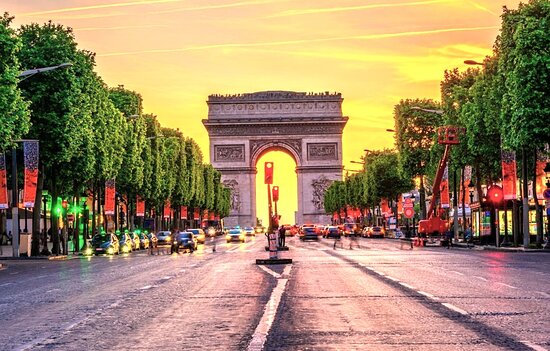 Photo via TripAdvisor (shukorTRAVEL)
Some booking links are affiliate links. If you book through them, we may earn a small commission at no extra cost to you. We never let this influence which places we recommend.
The Champs-Élysées is a 1.9-kilometre avenue in the 8th arrondissement of Paris, running between the Place de la Concorde and the Place Charles de Gaulle, where the Arc de Triomphe stands. It is known for its theatres, cafés, luxury shops, the finish of the Tour de France cycling race, and the annual Bastille Day military parade.
Don't miss
- The Arc de Triomphe at the western end, built to honor Napoleon's victories.
- The Obelisk of Luxor at the Place de la Concorde on the eastern end.
- The Grand Palais and Petit Palais, built for the Universal Exposition of 1900.
- The Jardin des Champs-Élysées, a park with gardens, fountains, and the Théâtre Marigny.
Tickets & tours
Ways to visit Champs-Élysées
You can see Champs-Élysées on your own. A tour is worth it for the story behind it, for transport, or for combining nearby sights into one day.
 Cheapest way inParis: Famous Graves of Pere Lachaise Cemetery Guided Tour4.6★ · 1,184 travelers~2 hoursFree cancellationFrom$22 per personSee dates →
 Most bookedVersailles Palace and Gardens Tour from Paris4.4★ · 4,231 travelers3-4 hoursFree cancellationFrom$74 per personSee dates →
 Top ratedFrench Wine and Champagne Tasting in Paris4.9★ · 667 travelers~2 hoursFree cancellationFrom$87 per personSee dates →
Getting there
Know before you go
- The avenue is 1.9 kilometres long and 70 metres wide.
- The Arc de Triomphe closes the western view, while the Luxor Obelisk marks the eastern end.
- The Jardin des Champs-Élysées forms the garden section near the Grand and Petit Palais.
A bit of history
The avenue was originally laid out in 1667 by André Le Nôtre as an extension of the Tuileries Garden, and was first called the 'Grand Cours'. It did not take the name Champs-Élysées until 1709. The Arc de Triomphe, commissioned by Napoleon after the Battle of Austerlitz, was completed in 1833–1836 under King Louis Philippe. In the 19th century, the avenue became fashionable, and the Élysée Palace, now the official residence of the French president, borders the park nearby.
Common questions
How long is the Champs-Élysées?
It is 1.9 kilometres (1.2 miles) long and 70 metres (230 feet) wide.
Why is the avenue called Champs-Élysées?
The name is French for the Elysian Fields, the place for dead heroes in Greek mythology.
When did the avenue receive its current name?
It was first called the Grand Cours and became the Champs-Élysées in 1709.
More attractions in Paris