Religious site
Thiên Mụ Temple
 Lưu Ly · Wikimedia Commons · Public domain
部分预订链接为联盟链接。通过它们预订,我们可能获得小额佣金,但不会增加你的费用。我们绝不会因此影响推荐。
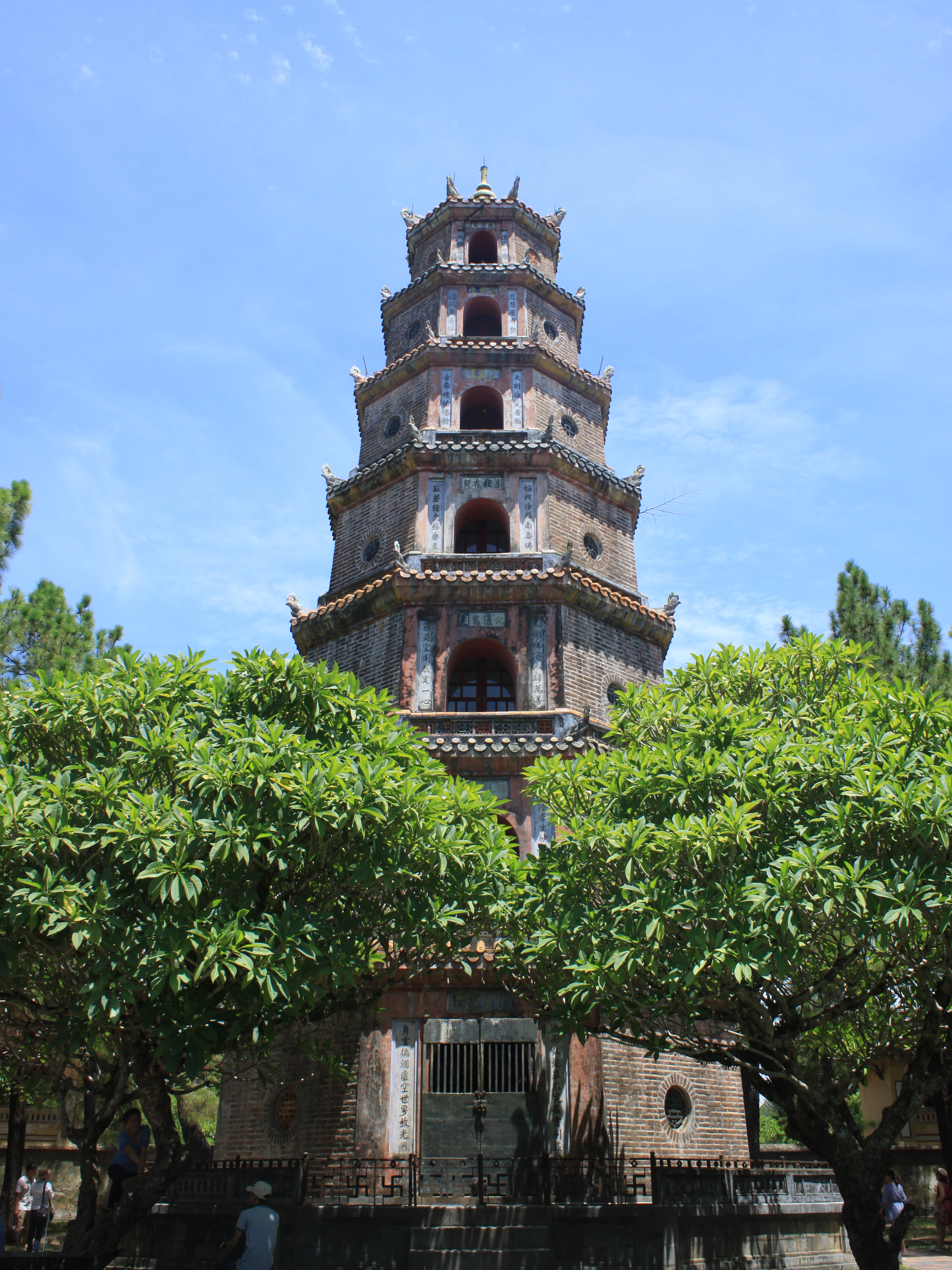
Thiên Mụ Temple stands on Hà Khê hill above the northern bank of the Perfume River, about 5 kilometres from Huế's Citadel. The historic Buddhist complex is closely identified with the city, largely because of the seven-storey Phước Duyên pagoda overlooking the river. Emperor Thiệu Trị erected the 21-metre octagonal tower in 1844, dedicating each level to a different Buddha. The grounds offer much more than the familiar riverside silhouette. Beside the tower is a large marble turtle, a symbol of longevity, as well as structures recording the tower's architectural history and poems by Thiệu Trị. In the main hall, Maitreya is flanked by Manjushri and Samantabhadra. The temple also preserves a giant bell cast in 1710 and the Austin car that carried Thích Quảng Đức to his 1963 self-immolation in Saigon. That vehicle connects this quiet religious setting to the Buddhist protest movement that challenged religious discrimination under President Ngô Đình Diệm.
不容错过
- Study the seven levels of Phước Duyên pagoda, each dedicated to a different Buddha.
- Find the 3,285-kilogram bell, traditionally said to be audible 10 kilometres away and celebrated in poems and songs.
- Look for the marble turtle and the nearby records of the tower's architecture and Emperor Thiệu Trị's poetry.
- See the Austin car that carried Thích Quảng Đức to his 1963 self-immolation in Saigon.
- In the main hall, identify Maitreya between Manjushri and Samantabhadra.
门票与行程
游览Thiên Mụ Temple的方式
你可以自行游览Thiên Mụ Temple。导游值得考虑,因为能提供历史和细节,这些容易错过,行程还可结合附近景点。
如何到达
行前须知
- The temple is on Hà Khê hill, on the northern bank of the Perfume River, around 5 kilometres from Huế's Citadel.
- The giant bell, marble turtle, main hall statues, and protest-era Austin car are separate details within the wider temple grounds.
历史背景
Nguyễn lord Nguyễn Hoàng ordered the temple's construction in 1601 after hearing a local story about an old woman called Thiên Mụ, the Celestial Lady. She was said to have foretold that a lord would build a pagoda on the hill for the country's prosperity. Later rulers repeatedly enlarged the site. Nguyễn Phúc Chu funded the 1710 bell and oversaw the temple's largest expansion in 1714, adding gates, shrines, teaching halls, scripture towers, meditation spaces, and living quarters. A cyclone severely damaged the complex in 1904, and reconstruction authorized by Emperor Thành Thái began in 1907. The temple later became a major organizing point during the 1963 Buddhist crisis, hosting protests, hunger strikes, and barricades. Its Austin car survives as a direct link to Thích Quảng Đức, whose self-immolation brought international attention to the treatment of Buddhists in South Vietnam.
常见问题
Why is Thiên Mụ Temple associated with the Celestial Lady?
A local story tells of an old woman called Thiên Mụ who foretold that a lord would build a pagoda on the hill. Nguyễn Hoàng ordered the temple built there in 1601.
What is the tall pagoda beside the river?
It is the 21-metre, seven-storey Phước Duyên pagoda, erected by Emperor Thiệu Trị in 1844. Each storey is dedicated to a different Buddha.
Why is an Austin car kept at the temple?
It carried the monk Thích Quảng Đức to his 1963 self-immolation in Saigon, an act that drew international attention to the Buddhist crisis in South Vietnam.
What survived from the temple's imperial patronage?
Among the surviving features are the 1710 bell, the 1844 Phước Duyên pagoda, imperial poetry, statues, shrines, and structures added or rebuilt under Nguyễn rulers.
Hue更多景点