Religious site
Carmo Convent
 Georges Jansoone · Wikimedia Commons · CC BY 2.5
Some booking links are affiliate links. If you book through them, we may earn a small commission at no extra cost to you. We never let this influence which places we recommend.
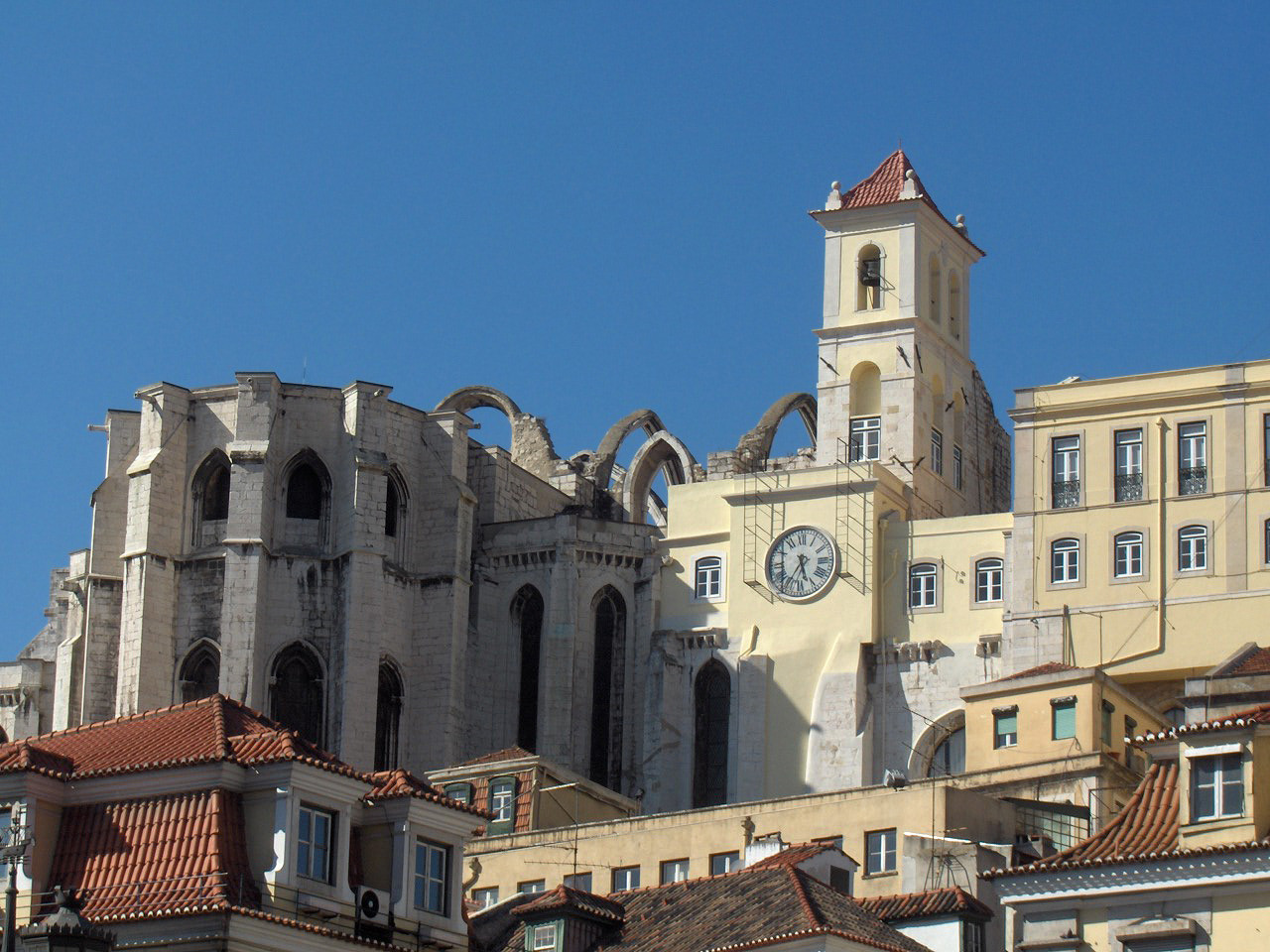
The Carmo Convent is a former Catholic convent in Lisbon, Portugal, whose Gothic church was ruined by the 1755 earthquake and remains a visible trace of that disaster. Today the open-roofed nave houses the Carmo Archaeological Museum, displaying artifacts from Portuguese prehistory through the medieval period.
Don't miss
- The open nave with only pointed arches surviving, as the stone roof collapsed in the 1755 earthquake and was never rebuilt.
- The main facade portal with archivolts and capitals carved with vegetal and anthropomorphic motifs, plus a partially destroyed rose window.
- Five flying buttresses on the south side, added in 1399 after the wall collapsed during construction.
- Gothic tombs including that of Fernão Sanches (a bastard son of King Dinis I) decorated with boar-hunting scenes, and the tomb of King Ferdinand I (reigned 1367–1383).
- Pre-historic objects from a fortification near Azambuja (3500–1500 BC) displayed in one of the old apse chapels.
- A statue of a 12th-century king, possibly Afonso Henriques, plus Moorish azulejos and Roman and Visigoth artifacts.
Tickets & tours
Ways to visit Carmo Convent
You can visit Carmo Convent on your own. A guide is worth it for the history and detail that is easy to walk past, and a tour can combine it with nearby sights.
 Cheapest way inAlfama and Mouraria Tour - The oldest neighbourhoods in Lisbon4.9★ · 524 travelers~3 hoursFree cancellationFrom$1 per personSee dates →
 Most bookedLisbon City Center Tour - The Unmissable Lisbon5★ · 24,780 travelers~3 hoursFree cancellationFrom$2 per personSee dates →
 Private & flexiblePrivate Tour Sesimbra Blue Coast5★ · 20 travelers~8 hoursFree cancellationFrom$146 per personSee dates →
Know before you go
- The convent is located in the Chiado neighborhood on a hill overlooking Rossio square and facing Lisbon Castle hill.
- It sits on a quiet square (Carmo Square) very close to the Santa Justa Lift.
- The ruined church is now an archaeological museum run by the Association of Portuguese Archaeologists.
A bit of history
Founded in 1389 by Constable Nuno Álvares Pereira, the convent was built on land from his sister and the admiral Pessanha. The 1755 earthquake destroyed its library of about 5,000 volumes and forced the 126 clerics to abandon the site. After serving as a police barracks, sawmill, and law court, it was donated in 1864 to the Association of Portuguese Archaeologists, which turned it into a museum. During the 1974 Carnation Revolution, the last regime president Marcelo Caetano surrendered here to future president António de Spínola.
Common questions
What caused the ruin of the Carmo Church?
The 1755 Lisbon earthquake destroyed the church's stone roof and library; the roof was never rebuilt, leaving the nave open to the sky.
What can I see inside the museum?
The nave and apse display architectural relics, Gothic tombs, pre-historic tools, Moorish tiles, and Roman and Visigoth objects.
Is the convent still used as a religious building?
No, it is a museum and also serves as the headquarters of the Republican Guard.
What historical event happened here in 1974?
During the Carnation Revolution, the last regime president Marcelo Caetano surrendered from the convent to António de Spínola.
More attractions in Lisbon