Religious site
Dohány Street Synagogue
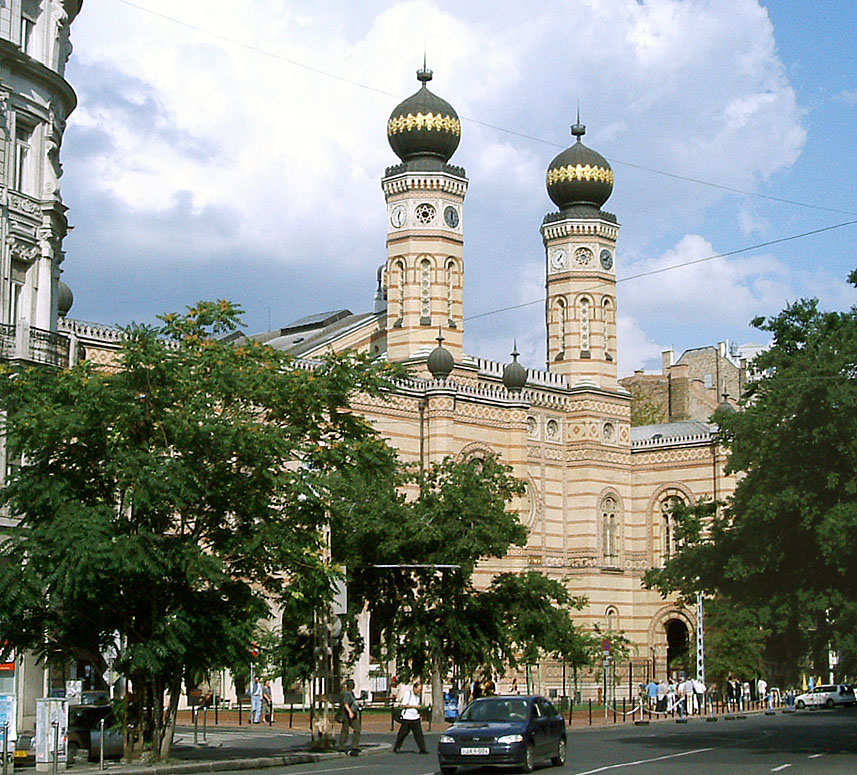 The original uploader was OsvátA at Hungarian Wikipedia. · Wikimedia Commons · CC BY-SA 3.0
Alcuni link di prenotazione sono link di affiliazione. Se prenoti tramite essi, potremmo guadagnare una piccola commissione senza costi aggiuntivi per te. Non lasciamo mai che questo influenzi i luoghi che consigliamo.
La Sinagoga di via Dohány è la più grande sinagoga d'Europa e un importante sito del patrimonio ebraico a Budapest. Costruita in stile neomoresco, il suo interno presenta archi ornamentali, una grande cupola e un imponente organo. Il complesso include il Museo Ebraico Ungherese e il Memoriale dell'Olocausto nel cortile, caratterizzato dalla suggestiva scultura dell'Albero della Vita. I visitatori approfondiscono la storia ebraica e la tragedia dell'Olocausto attraverso mostre e l'atmosfera solenne della sinagoga.
Da non perdere
- Ammirare l'architettura neomoresca e il grandioso interno della sinagoga
- Visitare il Museo Ebraico Ungherese per reperti e mostre storiche
- Riflettere al Memoriale dell'Olocausto con la scultura dell'Albero della Vita
Biglietti e tour
Come visitare Dohány Street Synagogue
Puoi visitare Dohány Street Synagogue da solo. Una guida vale la pena per la storia e i dettagli che è facile trascurare; un tour può abbinarlo ad altre attrazioni vicine.
 Il più economicoWalking Tour Budapest incl. the Shoes on the Danube Bank4.9★ · 393 viaggiatori~2 oreCancellazione gratuitaDa$4 a personaVedi date →
 Più prenotatoBudapest Danube Cruise and Dinner Options, Live Music and Dance4.7★ · 7542 viaggiatori~2 oreCancellazione gratuitaDa$57 a personaVedi date →
 Privato e flessibileBudapest Jewish Heritage: Synagogues, Shoes, Secrets4.8★ · 59 viaggiatori~3 oreCancellazione gratuitaDa$52 a personaVedi date →
Da sapere prima di andare
- The synagogue stands on Dohány Street in Budapest's Jewish quarter, within the central UNESCO World Heritage area.
- The complex includes a courtyard cemetery created during the 1944–1945 ghetto.
- A pipe organ is an unusual feature for a synagogue.
Un po' di storia
Built between 1854 and 1859 by the Jewish community of Pest, the synagogue was designed by Viennese architect Ludwig Förster in Moorish Revival and Romantic Historicist styles, with decoration based on Islamic models from North Africa and medieval Spain. It was consecrated on 6 September 1859. During World War II, it was used as a base for German Radio and a stable for animals, suffering severe damage from air raids. Restoration began in 1991 and was completed in 1998.
Domande frequenti
Why is there a cemetery next to the synagogue?
It is not customary to have a cemetery next to a synagogue, but this one was created out of necessity during the winter of 1944–1945 when over 2,000 people who died in the ghetto were buried in the courtyard.
What is the significance of the weeping willow memorial?
The memorial, called the Holocaust Tree of Life, is a weeping willow sculpture by Imre Varga with leaves bearing the names and tattoo numbers of victims, located in the Raoul Wallenberg Holocaust Memorial Park.
Can visitors see the original keys of the synagogue?
Yes, the keys and a silver trowel used to place the keystone in the Torah ark are kept at the adjacent Jewish Museum.
Who designed the synagogue and what style is it?
Viennese architect Ludwig Förster designed it in Moorish Revival and Romantic Historicist styles, with influences from Islamic architecture in North Africa and medieval Spain.
Altre attrazioni a Budapest