Sight
Temple of Olympian Zeus, Athens
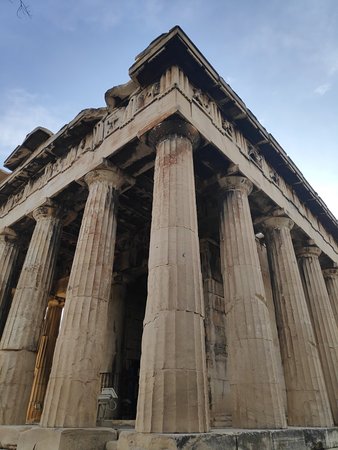 Photo via TripAdvisor (shlomitk2015)
Some booking links are affiliate links. If you book through them, we may earn a small commission at no extra cost to you. We never let this influence which places we recommend.
The Temple of Olympian Zeus is a colossal ruined temple in central Athens, dedicated to Zeus as head of the Olympian gods. Construction began in the 6th century BC under Athenian tyrants but was not finished until the Roman emperor Hadrian completed it in the 2nd century AD, about 638 years later. Originally it had 104 colossal columns and was the largest temple in Greece, housing one of the largest cult statues in the ancient world. Today, 16 of the original gigantic columns remain, with 15 still standing and one lying on the ground where it fell during a storm in 1852.
Don't miss
- 15 standing colossal Corinthian columns, each 17.25 m high and 1.70 m in diameter, plus one column lying on the ground from an 1852 storm
- The massive platform measuring 110.35 m by 43.68 m, originally supporting 104 columns
- The Arch of Hadrian at the northwest corner of the enclosure
- Statue bases of Hadrian found at regular intervals around the precinct
- Views of the Acropolis, about 500 m to the northwest
Tickets & tours
Ways to visit Temple of Olympian Zeus, Athens
You can usually visit on your own. A tour is worth it for transport, a guide, or combining nearby sights into one day.
 Cheapest way inAthens: Cape Sounion and Poseidon Temple Sunset with Audio Guide4.6★ · 423 travelers~5 hoursFree cancellationFrom$22 per personSee dates →
 Most bookedAcropolis and Parthenon Guided Walking Tour4.8★ · 6,019 travelers~2 hoursFree cancellationFrom$40 per personSee dates →
 Private & flexiblePrivate Luxury Tour: Athens Riviera & The Temple of Poseidon5★ · 20 travelers4-5 hoursFree cancellationFrom$151 per personSee dates →
Getting there
Know before you go
- The temple is about 500 m southeast of the Acropolis and about 700 m south of Syntagma Square.
- The site is part of the unified archaeological sites of Athens, protected by the Ephorate of Antiquities.
- The precinct was originally a walled marble-paved area measuring 250 x 130 m, adorned with many statues.
- A Greek inscription on one column records that the Turkish governor pulled it down on 27 April 1759 to reuse the marble.
A bit of history
The temple was built on the site of an ancient outdoor sanctuary to Zeus. An earlier temple was constructed by the tyrant Peisistratus around 550 BC, then demolished. Around 520 BC, his sons Hippias and Hipparchos began a colossal new temple to surpass the Heraion of Samos and the Temple of Artemis at Ephesus. Work stopped when the tyranny was overthrown in 510 BC, leaving only the platform and some column elements. The project was revived in 174 BC by Seleucid king Antiochus IV Epiphanes, who changed the design to Corinthian order and used Pentelic marble, but halted again at his death in 164 BC. The temple was sacked by Roman general Sulla in 86 BC, who took incomplete columns to Rome. Hadrian finally completed it around 124–125 AD, dedicating it in 132 AD. The temple was pillaged during a Germanic invasion in 267 AD and likely never repaired; an earthquake in the 5th century destroyed it. Over centuries, its marble was quarried for building materials. By 1436, only 21 columns remained standing.
Common questions
How many columns are still standing?
Fifteen columns remain standing, and a sixteenth lies on the ground where it fell during a storm in 1852.
Why was the temple built over so many centuries?
Construction began in the 6th century BC but was abandoned after the tyranny fell; it was revived by Antiochus IV in 174 BC and finally completed by Hadrian in the 2nd century AD, about 638 years after it started.
What happened to the cult statue?
The cella housed a colossal chryselephantine statue of Zeus, but nothing remains of it or the cella today.
Is the temple still used for events?
In modern times it has been used for public cultural and religious events, such as a 2001 concert by Vangelis and a 2007 ceremony by the group Ellinais.
What is the Arch of Hadrian?
It is a monumental arch standing at the northwest corner of the temple enclosure, built during Hadrian's reign.
More attractions in Athens