Landmark
Odeonsplatz
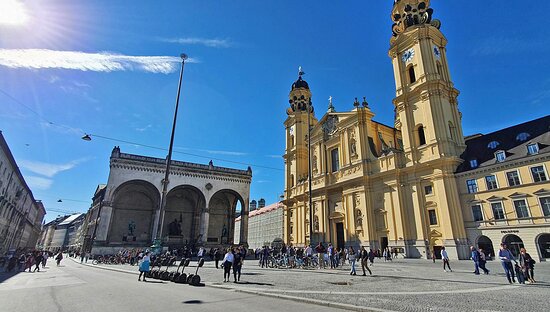 Photo via TripAdvisor (MikaelF413)
Some booking links are affiliate links. If you book through them, we may earn a small commission at no extra cost to you. We never let this influence which places we recommend.
Odeonsplatz is a large square in central Munich, developed in the early 19th century by Leo von Klenze. It sits at the southern end of Ludwigstraße and includes the forecourt of the Residenz, in front of the Theatine Church, terminated by the Feldherrnhalle. The square was the scene of a fatal gun battle that ended the 1923 Beer Hall Putsch.
Don't miss
- The Feldherrnhalle, a copy of Florence's Loggia dei Lanzi, closes the view at the southern end.
- The Odeon building (now Bavarian Ministry of the Interior) and Palais Leuchtenberg (now Bavarian State Ministry of Finance) on the west side, both modelled on Rome's Palazzo Farnese.
- Klenze's Bazaar Building on the east side, which includes Café Tambosi.
- An equestrian statue of Ludwig I at the mouth of the street between the Odeon and Palais Leuchtenberg, designed by Ludwig von Schwanthaler.
- A plaque on the wall of the Residenz (added in 2010) commemorating the four police officers killed in the 1923 Beer Hall Putsch.
Tickets & tours
Ways to visit Odeonsplatz
You can see Odeonsplatz on your own. A tour is worth it for the story behind it, for transport, or for combining nearby sights into one day.
 Cheapest way inMunich Old Town Walking Tour4.6★ · 161 travelers~2 hoursFree cancellationFrom$26 per personSee dates →
 Best full dayNeuschwanstein Castle & Linderhof Day Tour from Munich4.4★ · 7,468 travelers~11 hoursFree cancellationFrom$86 per personSee dates →
 Private & flexibleThe Perfect Start: Munich PRIVATE Tour with Optional Breakfast5★ · 17 travelers3-4 hoursFree cancellationFrom$145 per personSee dates →
Know before you go
- Since 1972, the southern end of the square has been part of the central Munich pedestrian zone.
- The square was the subject of at least one painting by Hitler and features in a famous 1914 photograph of cheering crowds at the outbreak of World War I.
A bit of history
The square's current form was determined by King Ludwig I, who in 1816 commissioned Klenze to lay out Ludwigstraße and the square at its southern end. The Italianate neo-classical style was set by the first building, Palais Leuchtenberg. The Feldherrnhalle, a copy of Florence's Loggia dei Lanzi, was added in 1840–41 by Klenze's rival Friedrich von Gärtner. Odeonsplatz has traditionally been a site for parades and public events, including funeral processions and victory parades; the annual Oktoberfest parade still follows this route.
Common questions
What is the historical significance of Odeonsplatz?
It was the site of a fatal gun battle that ended the 1923 Beer Hall Putsch, and during the Third Reich an annual memorial march passed through the square.
Which buildings surround the square?
Notable buildings include the Odeon (now Bavarian Ministry of the Interior), Palais Leuchtenberg (now Bavarian State Ministry of Finance), Klenze's Bazaar Building with Café Tambosi, and the Feldherrnhalle.
What do the memorial plaques commemorate?
They name four police officers killed when the 1923 Beer Hall Putsch ended in gunfire at the square.
More attractions in Munich