Religious site
One Pillar Pagoda
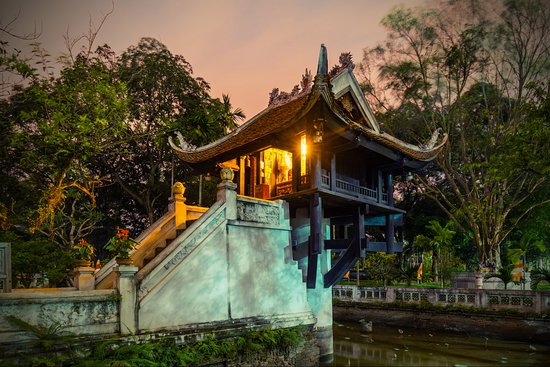 Photo via TripAdvisor (Management)
Some booking links are affiliate links. If you book through them, we may earn a small commission at no extra cost to you. We never let this influence which places we recommend.
The One Pillar Pagoda is a historic Buddhist temple in central Hanoi, near the Thăng Long Citadel. Its most famous structure is a wooden temple built on a single stone pillar, designed to resemble a lotus blossom, a Buddhist symbol of purity. It is regarded as one of Vietnam's two most iconic temples.
Don't miss
- The wooden temple perched on a single stone pillar 1.25 meters in diameter and 4 meters high.
- The lotus blossom design, symbolizing purity, as a lotus blooms from muddy water.
- Its location near the Ho Chi Minh Mausoleum and Museum.
Tickets & tours
Ways to visit One Pillar Pagoda
You can visit One Pillar Pagoda on your own. A guide is worth it for the history and detail that is easy to walk past, and a tour can combine it with nearby sights.
 Cheapest way inPerfume Pagoda Full-Day Guided Tour from Hanoi - All Inclusive4.4★ · 59 travelers~10 hoursFree cancellationFrom$38 per personSee dates →
 Best full dayHanoi City Tour Full Day ALL IN ONE - ALL INCLUDED4.9★ · 291 travelers~8 hoursFree cancellationFrom$39 per personSee dates →
 Top ratedExploring Bai Dinh Pagoda -Trang An -Mua Cave with Buffet Lunch 1 Day From Hanoi4.9★ · 235 travelers11-12 hoursFree cancellationFrom$48 per personSee dates →
Know before you go
- The pagoda is tucked away between the Ho Chi Minh Mausoleum and Museum.
- The pagoda was rebuilt in 1955 after being destroyed in 1954, not by the French but by a Vietnamese lieutenant.
A bit of history
Emperor Lý Thái Tông built the original pagoda in 1049 after dreaming that the Bodhisattva Avalokiteśvara handed him a baby son while seated on a lotus flower. The emperor later married a peasant girl and had a son, constructing the temple in gratitude. The pagoda was renovated in 1105 by Emperor Lý Nhân Tông, and a large bell was cast in 1109 but could not be installed; it was later melted down for weapons during the Ming occupation. In 1954, a Vietnamese lieutenant of the French army dynamited the pagoda, and it was restored in 1955 by the Ministry of Culture.
Common questions
Why was the One Pillar Pagoda built?
Emperor Lý Thái Tông built it in 1049 after a dream where a bodhisattva gave him a baby son on a lotus flower; he later had a son and built the temple in gratitude.
What is the pagoda's architecture like?
It is a wooden temple on a single stone pillar, designed to resemble a lotus blossom, a Buddhist symbol of purity.
Was the pagoda destroyed in war?
Yes, it was dynamited in 1954 by a Vietnamese lieutenant of the French army, then restored in 1955.
More attractions in Hanoi