Landmark
Casa Batlló
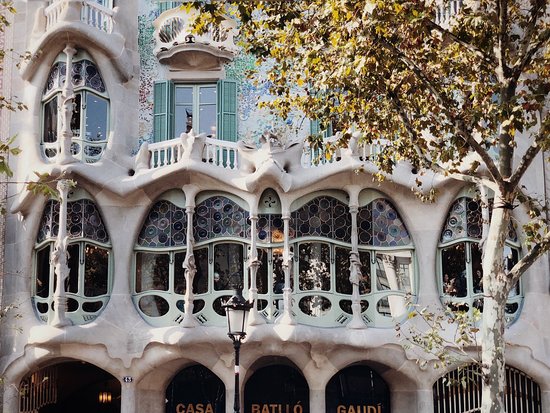 Photo via TripAdvisor
Một số liên kết đặt chỗ là liên kết tiếp thị liên kết. Nếu bạn đặt qua đó, chúng tôi có thể nhận một khoản hoa hồng nhỏ mà bạn không phải trả thêm chi phí. Điều này không bao giờ ảnh hưởng đến những địa điểm chúng tôi giới thiệu.
Casa Batlló là một căn nhà phố kỳ quặc dường như mọc lên tự nhiên từ lòng đất. Mặt tiền của nó, được phủ bằng kỹ thuật trencadís từ những mảnh gốm xanh, xanh lá và vàng, gợn sóng như mặt nước, trong khi các ban công giống như hộp sọ hay mặt nạ – do đó có biệt danh là Ngôi nhà của Xương. Bên trong, mọi chi tiết đều cong: cầu thang uốn lượn như xương sống, trần của sảnh chính xoáy như vòng xoáy, và giếng trời được lát gạch với các sắc xanh đậm dần khi bạn lên cao, đảm bảo ánh sáng phân bố đều. Mái nhà được điểm nhấn bởi một đường gờ có vảy như lưng rồng, thường được cho là tượng trưng cho lưng con rồng bị Thánh George, vị thánh bảo trợ của Catalonia, giết chết. Gác mái với những vòm parabol gợi nhớ đến lồng xương sườn. Một hướng dẫn thực tế tăng cường (AR) làm sống động ngôi nhà, cho thấy đồ nội thất nguyên bản của Gaudí và sự phát triển của tòa nhà. Đây là một trải nghiệm vui tươi, sống động, thể hiện thiên tài của Gaudí trong việc pha trộn cấu trúc với trí tưởng tượng.
Đừng bỏ lỡ
- Ngắm nhìn mặt tiền phủ mosaic với những ban công hình mặt nạ và cột giống xương
- Khám phá sảnh chính với trần xoáy và cửa sổ kính màu
- Leo lên mái nhà để thấy xương sống rồng và ống khói đầy màu sắc
- Tham quan gác mái với những vòm parabol, gợi nhớ lồng xương sườn
- Sử dụng hướng dẫn thực tế tăng cường để thấy ngôi nhà như Gaudí từng thiết kế
Vé & tour
Cách tham quan Casa Batlló
Bạn có thể tự ngắm Casa Batlló. Tour đáng giá nhờ câu chuyện đằng sau, phương tiện di chuyển, hoặc kết hợp các điểm tham quan lân cận trong một ngày.
 Rẻ nhất trongCatamaran Sailing Cruise in Barcelona4.2★ · 55 khách~1 giờHủy miễn phíTừ$16 mỗi ngườiXem ngày →
 Được đặt nhiều nhấtCasa Batllo Admission Ticket with Intelligent Audio Guide4.4★ · 3.317 khách1-2 giờTừ$52 mỗi ngườiXem ngày →
 Riêng tư & linh hoạtBarcelona Essentials Private Tuk-Tuk Tour.4.8★ · 19 khách1-4 giờHủy miễn phíTừ$22 mỗi ngườiXem ngày →
Getting there
Cần biết trước khi đi
- Casa Batlló is a remodeled 1877 apartment building, not a structure Gaudí built entirely from the ground up.
- The light well's tiles darken toward the top and lighten below to spread daylight more evenly.
- The dragon-back roof and Saint George's lance form a common interpretation of the design.
- Public access began with the noble floor in 2002 and later expanded to the loft and light well.
Một chút lịch sử
The Batlló family's commission emerged from the social rivalry of early twentieth-century Passeig de Gràcia. Josep Puig i Cadafalch had remodeled neighboring Casa Amatller, and Lluís Domènech i Montaner had worked nearby, helping earn the block its nickname. Gaudí submitted his renovation plan in 1904 and completed the house in 1906. He transformed the Batlló family's main apartment, enlarged the central light well, improved ventilation, added floors, and reshaped the exterior. Barcelona's city council nominated the house for its 1906 best-building award, though another project won. The family retained the property after Josep Batlló died in 1934 and his wife died in 1940. An insurance company acquired it in 1954 and adapted rooms for offices. Later restoration campaigns treated interior spaces, balcony colors, the elevator, and the façade. The Bernat family, associated with Chupa Chups, bought Casa Batlló in 1993 and pursued restoration and maintenance. Event use began in 1995. The noble floor opened for public visits in 2002 during the International Year of Gaudí. Restoration of the fifth floor followed, and access expanded to the loft and light well around the centenary of the renovation. The building evolved from a private residence to offices, an event venue, and a museum open to visitors.
Câu hỏi thường gặp
Did Gaudí build Casa Batlló from scratch?
No. Emili Sala Cortés built the original house in 1877. Gaudí extensively remodeled it for Josep Batlló from 1904 to 1906.
Why is it called the House of Bones?
The local nickname refers to the façade's skeletal, biomorphic forms, especially its curved stonework and bone-like balcony shapes.
What is the Block of Discord?
It is the Passeig de Gràcia block where Casa Batlló stands among dramatically different buildings by major Modernista architects.
How did Gaudí bring light into the house?
He enlarged the central well and used blue tiles with changing intensity, windows, shutters, and a skylight to distribute light and support ventilation.
What was the loft originally used for?
It served tenants as a laundry and storage area. Its sixty catenary arches now form one of the building's most distinctive interiors.
Thêm điểm tham quan ở Barcelona