Religious site
Muradiye Complex
 Bernard Gagnon · Wikimedia Commons · CC BY-SA 3.0
Some booking links are affiliate links. If you book through them, we may earn a small commission at no extra cost to you. We never let this influence which places we recommend.
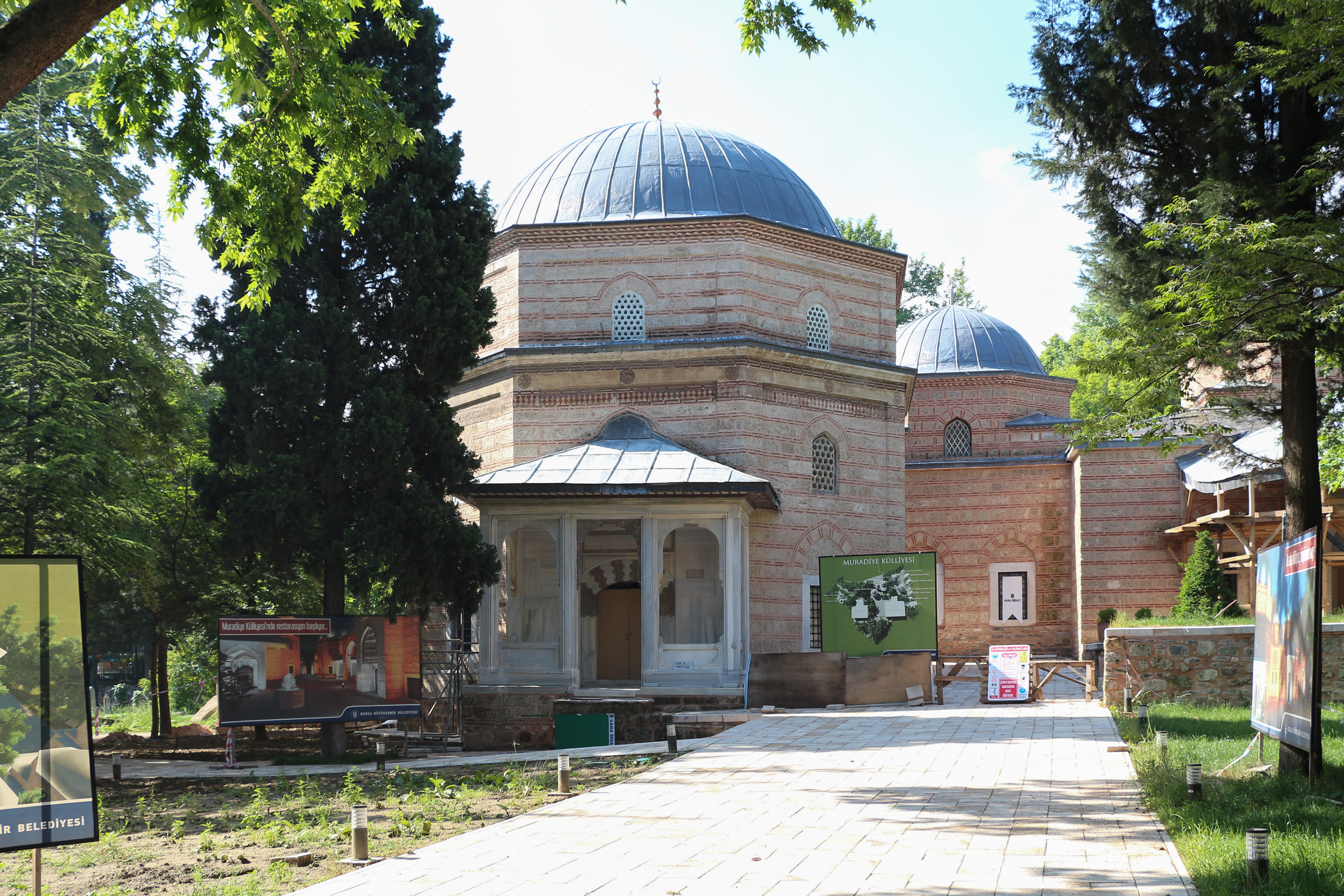
The Muradiye Complex is a historic Ottoman religious and social complex in Bursa, commissioned by Sultan Murad II. It includes a mosque, madrasa, bath, hospice, fountain, epitaphs, and twelve tombs of Ottoman nobles. The site is part of the UNESCO World Heritage listing for Bursa.
Don't miss
- The mosque's simplified inverse T plan with a domed portico and four major domes, built of brick.
- Interior decoration of hexagonal tiles in turquoise and dark blue.
- Two minarets: one original and one rebuilt in 1904 after the 1855 earthquake collapsed the earlier one.
- The madrasa's central courtyard surrounded by student rooms and a domed classroom, with dark blue and turquoise tiles inside.
- The tomb of Murad II, with a square plan, open-top dome, vaulted gallery on Byzantine capitals, and a carved wooden canopy with star patterns.
- Eight mausoleums containing tombs of early Ottoman nobles, including those of Şehzade Mustafa and Mahidevran Hatun decorated with 16th-century painted Iznik tiles.
Getting there
Know before you go
- The complex combines a mosque, madrasa, bath, hospice, fountain, inscriptions, and twelve Ottoman tombs.
- Look for turquoise and dark-blue hexagonal tilework in the mosque interior.
- The mosque's rococo-style mihrab was rebuilt after an early 18th-century fire.
A bit of history
Construction began after the Yeşil Mosque was completed, with the mosque finished in 1426. A major earthquake in 1855 caused extensive damage, and restorations were carried out in the late 19th century, with another restoration completed in 2015. The madrasa served as a tuberculosis clinic in the 1950s.
Common questions
Who commissioned the Muradiye Complex?
It was commissioned by Sultan Murad II, who reigned from 1421 to 1451 with a brief interruption.
How many tombs are in the complex?
There are twelve tombs, most belonging to relatives of Sultan Murad II.
What caused damage to the complex in the 19th century?
A large earthquake in 1855 damaged much of the complex, leading to restorations in the late 19th century.
What is unique about the tomb of Murad II?
Its dome is left open at the top, and it features a vaulted gallery resting on Byzantine capitals, plus a carved wooden canopy with star patterns.
Are there any special tiles to see?
Yes, the tombs of Şehzade Mustafa and Mahidevran Hatun are decorated with 16th-century painted Iznik tiles in polychrome technique.
More attractions in Bursa