Sight
Basilica Cistern
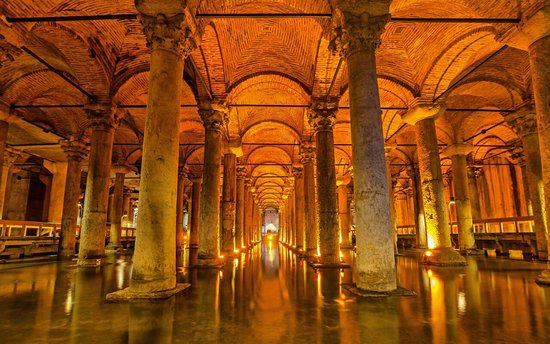 Photo via TripAdvisor (silvy135)
Alguns links de reserva são links de afiliados. Se você reservar por eles, podemos ganhar uma pequena comissão sem custo extra para você. Nunca deixamos que isso influencie os lugares que recomendamos.
A Basílica Cisterna, construída no século VI durante o reinado do Imperador Justiniano, é um dos pontos turísticos mais atmosféricos de Istambul. Os visitantes caminham por plataformas elevadas sobre águas rasas, cercados por uma floresta de colunas refletidas na piscina mal iluminada. A atmosfera misteriosa da cisterna é intensificada pelas duas cabeças de Medusa usadas como bases de colunas, uma colocada de lado, a outra de cabeça para baixo. Originalmente abastecendo o Grande Palácio, esta maravilha subterrânea agora recebe concertos ocasionais e instalações de arte, misturando história com cultura moderna.
Não perca
- Admire as duas cabeças de Medusa esculpidas, uma colocada de lado e a outra de cabeça para baixo, cujas origens permanecem um mistério
- Caminhe pelas passarelas elevadas e observe o reflexo das 336 colunas de mármore na água rasa
- Procure a coluna 'Olho de Galinha', esculpida com padrões de lágrimas e um buraco que dizem realizar desejos
Ingressos e passeios
Formas de visitar Basilica Cistern
Geralmente você pode visitar por conta própria. Um passeio vale a pena pelo transporte, guia ou para combinar atrações próximas em um dia.
 Mais baratoHagia Sophia, Blue Mosque & Basilica Cistern tour4.8★ · 72 viajantes2-3 horasCancelamento grátisA partir de$23 por pessoaVer datas →
 Mais reservadoIstanbul: Blue Mosque, Hagia Sophia & opt. Cistern Tour4.9★ · 474 viajantes~3 horasCancelamento grátisA partir de$64 por pessoaVer datas →
 Privado e flexívelIstanbul Guided Tour: Hagia Sophia, Basilica Cistern and More!5★ · 64 viajantes5-7 horasCancelamento grátisA partir de$105 por pessoaVer datas →
Saiba antes de ir
- The cistern originally held water from the Eğrikapı Water Distribution Centre in the Belgrade Forest, 19 km north, via the Valens and Mağlova aqueducts.
- The majority of columns were recycled from older buildings (spoliation), carved from different types of marble and granite.
- The cistern was used as a location for the 1963 James Bond film From Russia with Love.
- The cistern appears in the 2011 video game Assassin's Creed: Revelations and the 2013 Dan Brown novel Inferno.
Um pouco de história
The cistern was called Basilica because it sat beneath the Stoa Basilica, a large public square on the First Hill of Constantinople. Ancient texts indicate the site originally held a great basilica built during the Early Roman Age between the 3rd and 4th centuries as a commercial, legal, and artistic centre. Historical texts claim 7,000 slaves were involved in its construction. Its existence was eventually forgotten by all but locals until the French traveller Petrus Gyllius recorded it in 1565, noting being rowed between columns and seeing fish swimming beneath the boat.
Perguntas frequentes
How large is the Basilica Cistern?
It is an underground chamber approximately 138 metres by 65 metres, covering about 9,800 square metres, capable of holding 80,000 cubic metres of water.
Why is it called the Basilica Cistern?
It was called Basilica because it was located under a large public square called the Stoa Basilica on the First Hill of Constantinople.
What are the Medusa heads in the cistern?
Two column bases in the northwest corner reuse blocks carved with the face of Medusa. Their origin is unknown, but they are thought to have been brought from a late Roman building.
When was the cistern opened to the public?
It opened as a museum in 1987 after a major restoration that removed over 50,000 tons of silt and introduced elevated wooden walkways.
What restoration happened between 2020 and 2022?
A comprehensive restoration replaced iron tie-rods with stainless-steel compression rods, removed concrete walkways and cement render, revealed the original Byzantine brick floor, installed a new modular steel walkway, and added LED lighting and sensors.
Mais atrações em Istambul