Religious site
Santa Maria Novella
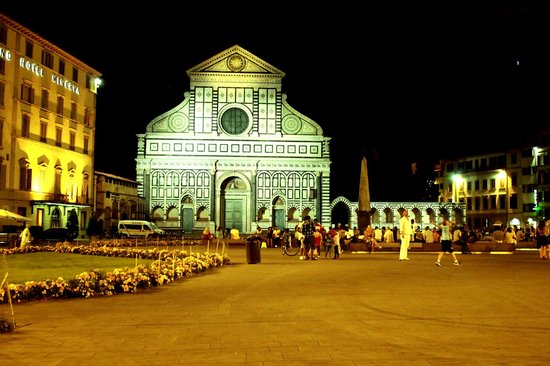 Photo via TripAdvisor (MigsDeManille)
Some booking links are affiliate links. If you book through them, we may earn a small commission at no extra cost to you. We never let this influence which places we recommend.
Santa Maria Novella is a Dominican church in Florence, considered the most important Romano-Gothic church in Tuscany and a World Heritage Site. Its construction began around 1276 and took nearly 200 years, with consecration in 1420. The distinctive façade features geometric patterns of white marble and green serpentinite from Prato.
Don't miss
- Giotto's Crucifix, which changed how Christ was depicted on the cross for two centuries
- Masaccio's Holy Trinity, the first monumental Renaissance painting to use linear perspective
- The Tornabuoni Chapel frescoes by Domenico Ghirlandaio, where the young Michelangelo was an apprentice
- The Spanish Chapel frescoes by Andrea di Bonaiuto, including an Allegory of the Active and Triumphant Church
- The pulpit designed by Filippo Brunelleschi, from which Father Tommaso Caccini denounced Galileo's heliocentrism
- The armillary sphere and astronomical quadrant on the façade, added in 1572 by astronomer Ignazio Danti
Tickets & tours
Ways to visit Santa Maria Novella
You can visit Santa Maria Novella on your own. A guide is worth it for the history and detail that is easy to walk past, and a tour can combine it with nearby sights.
 Cheapest way inSmall Group Florence Cathedral Guided Tour with Priority Access4.1★ · 198 travelers~1 hourFree cancellationFrom$28 per personSee dates →
 Most bookedUffizi & Accademia Timed Entry: Small Group Duomo Walking Tour4.7★ · 3,837 travelers~4 hoursFrom$57 per personSee dates →
 Private & flexibleFlorence Golf Cart Tour with Piazzale Michelangelo or Fiesole4.9★ · 89 travelers1-2 hoursFree cancellationFrom$66 per personSee dates →
Getting there
Know before you go
- The church is a World Heritage Site and considered the most important Romano-Gothic church in Tuscany.
- Many artworks were financed by rich Florentine families, who were granted funerary chapels inside.
- Look for the armillary sphere and gnomon on the lower façade, used to calculate the discrepancy in the Julian calendar.
- The nave has a trompe-l'œil effect: the piers are progressively closer near the chancel, making it seem longer.
A bit of history
In 1221, the Florence Diocese assigned the oratory of Santa Maria delle Vigne to the Dominicans, who built a new church named Santa Maria Novella. The church was consecrated in 1420 by Pope Eugene IV, and in 1919 Pope Benedict XV elevated it to a minor basilica. The interior was remodeled to host the Council of Florence (1439–1441).
Common questions
What is the most famous artwork in Santa Maria Novella?
Two standout works are Giotto's Crucifix and Masaccio's Holy Trinity, the first Renaissance painting to use linear perspective.
Why is the Spanish Chapel called that?
It was assigned to Eleonora of Toledo and her Spanish retinue by Cosimo I, hence the name 'Spanish Chapel'.
What is the significance of the astronomical instruments on the façade?
Added in 1572 by Ignazio Danti, they helped calculate the error in the Julian calendar, contributing to the Gregorian calendar reform.
Is there a connection to Galileo?
The pulpit designed by Brunelleschi is where Father Tommaso Caccini denounced Galileo's defense of heliocentrism.
What is the 'Palio dei Cocchi'?
A yearly chariot race held in the square in front of the church from 1563 to the late 19th century, marked by two obelisks on bronze tortoises.
More attractions in Florence