Religious site
Old Jewish Cemetery, Prague
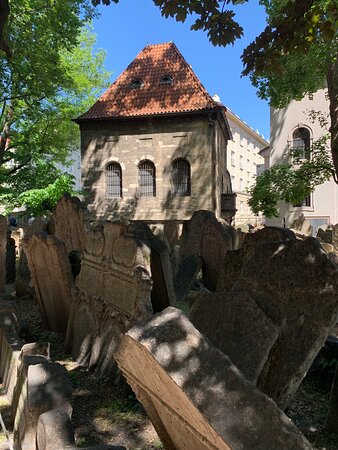 Photo via TripAdvisor (AngelicaCora1912)
Some booking links are affiliate links. If you book through them, we may earn a small commission at no extra cost to you. We never let this influence which places we recommend.
The Old Jewish Cemetery in Prague is one of the largest Jewish cemeteries in Europe and a key historical monument. It was used from the early 15th century until 1786. Because of limited space, burials were stacked in up to twelve layers, creating a dense, raised field of gravestones that now sits above the surrounding streets.
Don't miss
- The oldest gravestone (1439) of rabbi and poet Avigdor Kara, whose elegy about the 1389 pogrom is still recited on Yom Kippur at the Old-New Synagogue.
- The tumba of Rabbi Judah Löw ben Betzalel (Maharal), decorated with a lion and wine grapes, associated with the Golem legend.
- The ornate tumba of Hendl Bassevi (died 1628), featuring lions that carry the coat of arms of her husband Jacob Bassevi, the first Jew in the Habsburg Empire to receive a title of nobility.
- The gravestone of David Gans (1541–1613), marked with a Star of David and a goose, honoring a mathematician, astronomer, and historian.
- The tumba of Mordecai Maisel (1528–1601), a businessman and benefactor who built a synagogue in the Jewish quarter.
- The hill Nephele, where children who died before one month of age were buried, along with remains and gravestones moved during modern construction.
Tickets & tours
Ways to visit Old Jewish Cemetery, Prague
You can visit Old Jewish Cemetery, Prague on your own. A guide is worth it for the history and detail that is easy to walk past, and a tour can combine it with nearby sights.
 Cheapest way inPrague Essential Tour Old Town and Jewish Quarter5★ · 549 travelers~3 hoursFree cancellationFrom$3 per personSee dates →
 Most bookedPrague Old Town, Medieval Underground and Dungeon Historical Tour4.7★ · 4,804 travelers~2 hoursFree cancellationFrom$31 per personSee dates →
 Private & flexiblePrague´s Old Town, Jewish Quarter and Charles Bridge Private Tour5★ · 13 travelers~3 hoursFree cancellationFrom$131 per personSee dates →
Know before you go
- The cemetery is administered by the Jewish Museum in Prague.
- Gravestones feature Hebrew inscriptions with the deceased's name and date of death, and from the 16th century, symbols hinting at their life, character, name, or profession.
A bit of history
The cemetery's oldest gravestone dates from 1439, belonging to rabbi and poet Avigdor Kara. Burials continued until 1787, when Emperor Josef II banned interments inside the city walls for hygienic reasons. The cemetery's layered graves resulted from a lack of space and the Jewish prohibition on removing old graves; new soil was added on top, and older gravestones were either covered or raised to the new surface.
Common questions
Why are the gravestones so close together?
Over 300 years, the cemetery ran out of space. Instead of removing old graves, new layers of soil were added on top, sometimes creating up to twelve layers. Older gravestones were either covered or raised to the new surface, resulting in the dense cluster you see today.
Who is buried in the oldest grave?
The oldest gravestone, from 1439, belongs to rabbi and poet Avigdor Kara. His elegy describing the 1389 pogrom of the Prague Ghetto is still recited on Yom Kippur at the Old-New Synagogue.
What is the hill Nephele?
Nephele (meaning 'miscarriage' in Hebrew) is a section where children who died before one month of age were buried. Remains and gravestones found during modern construction in Prague were also transferred there.
More attractions in Prague