Landmark
Giant Wild Goose Pagoda
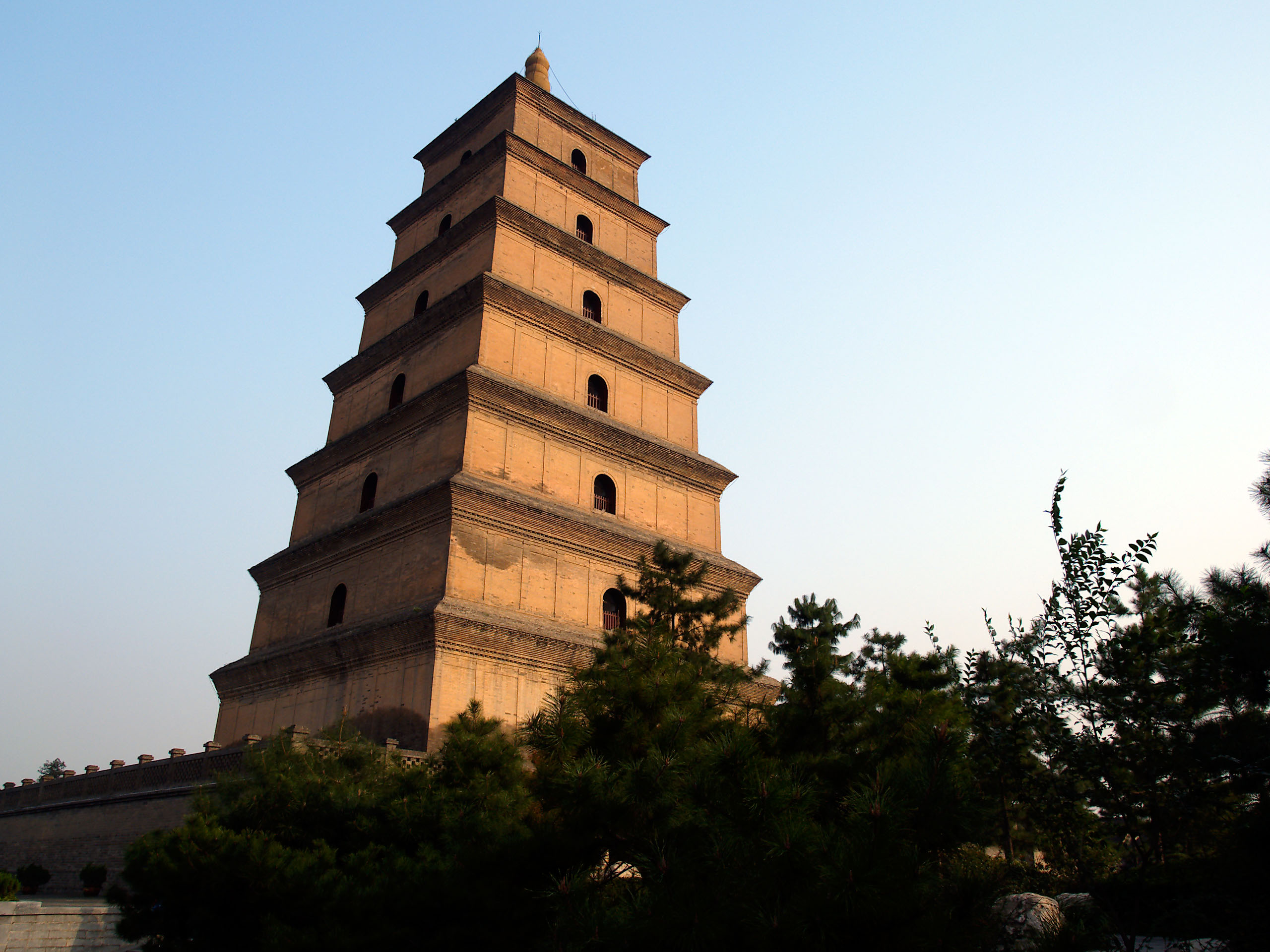 Alex Kwok · Wikimedia Commons · CC BY-SA 3.0
Some booking links are affiliate links. If you book through them, we may earn a small commission at no extra cost to you. We never let this influence which places we recommend.
The Giant Wild Goose Pagoda is a seven-story brick pagoda in southern Xi'an, built in 652 AD during the Tang dynasty. It was originally constructed to house Buddhist scriptures and figurines brought from India by the monk Xuanzang. Today, you can climb 248 steps to the top and see engraved Buddha statues on the interior walls.
Don't miss
- Stone tablets outside the south door with the 'Preface to the Sacred Teachings of the Great Tang Sanzang' by Emperor Taizong and a companion text by Emperor Gaozong, inscribed by calligrapher Chu Suiliang
- Engraved Buddha and Heavenly King statues on the stone door lintels of the first floor
- Frescoes on each level depicting Xuanzang's journey to the west to retrieve scriptures
- West lintel carving of Amitabha Buddha giving a sermon
- Coiled chi dragon engraving on top of the stone tablets, with celestial beings dancing and playing music on the pedestal
Tickets & tours
Ways to visit Giant Wild Goose Pagoda
You can see Giant Wild Goose Pagoda on your own. A tour is worth it for the story behind it, for transport, or for combining nearby sights into one day.
 Cheapest way inTerracotta Army+Gaint Goose Pagoda+City Wall Bus Tour with Option4.8★ · 10 travelers~9 hoursFree cancellationFrom$17 per personSee dates →
 Best full dayMini Group Xian Day Tour to Terracotta Army, City Wall, Pagoda and Muslim Bazaar4.9★ · 1,542 travelers9-10 hoursFree cancellationFrom$24 per personSee dates →
 Private & flexibleXi’an Private Day Tour:Terracotta Army, City Wall, Pagoda&Pottery5★ · 31 travelers~8 hoursFree cancellationFrom$25 per personSee dates →
Getting there
Know before you go
- The pagoda is located in the northern part of Daci'en Temple in southern Xi'an.
- There are 248 steps inside the pagoda to reach the top.
- The pagoda was added to the UNESCO World Heritage List in 2014 as part of the Silk Roads: Chang'an-Tianshan Corridor.
A bit of history
The pagoda was built in 652 under Xuanzang's supervision to preserve Sanskrit scriptures he brought from India. It was rebuilt in 704 during Empress Wu Zetian's reign, expanded to ten stories later, then reduced back to seven after war damage. The current brick exterior dates from the Ming dynasty. The pagoda began tilting due to groundwater over-exploitation; by 1996 the tilt reached about 1 meter, but well-sealing measures since then have helped it gradually return to its original position.
Common questions
Why is it called Wild Goose Pagoda?
The most widely accepted theory is that the name comes from a legend about 'burying a wild goose and building a pagoda.'
How tall is the pagoda?
The total height, including the base, is 64.1 meters. The base is about 4.2 meters high.
Is the pagoda leaning?
Yes, it began tilting due to groundwater over-exploitation. By 1996 the tilt reached about 1 meter, but well-sealing measures since 1996 have helped it gradually return to its original position.
More attractions in Xi'an