Landmark
Hofburg
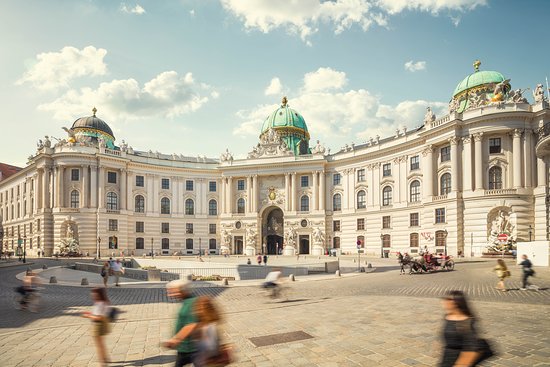 Photo via TripAdvisor (Management)
Some booking links are affiliate links. If you book through them, we may earn a small commission at no extra cost to you. We never let this influence which places we recommend.
The Hofburg is the former principal imperial palace of the Habsburg dynasty in Vienna, built from the 13th century onward. It served as the imperial winter residence (Schönbrunn was the summer residence) and has been the official residence and workplace of the president of Austria since 1946. The complex includes the Swiss Court, the Amalienburg, the imperial chapel, the imperial library, the treasury, the Spanish Riding School, and the Burgtheater, among other buildings.
Don't miss
- Swiss Court (Schweizerhof): the oldest part, with a Gothic chapel and the treasury holding the imperial insignia of the Holy Roman Empire and the Empire of Austria.
- Swiss Gate (Schweizertor): a Renaissance entrance displaying the many titles of Emperor Ferdinand I and the Order of the Golden Fleece on the ceiling.
- Amalienburg: a late Renaissance residence named after Empress Amalie Wilhelmine, with a small tower, cupola, and astronomical clock on its façade.
- Leopoldine Wing: built under Emperor Leopold I, now housing the offices of the Federal President.
- Court Library (Prunksaal): a grand hall with a ceiling fresco by Daniel Gran, statues of emperors by Paul Strudel, and the book collection of Prince Eugene of Savoy.
- Augustinian Church: used by the Habsburgs for weddings, including that of Emperor Franz Joseph I and Empress Elisabeth (Sisi).
Tickets & tours
Ways to visit Hofburg
You can see Hofburg on your own. A tour is worth it for the story behind it, for transport, or for combining nearby sights into one day.
 Cheapest way inVienna: Freud, Mozart & Beethoven Exploration Game4.1★ · 14 travelers1-2 hoursFree cancellationFrom$7 per personSee dates →
 Most bookedBest of Vienna : Historic Center Walking Tour4.9★ · 1,918 travelers~3 hoursFree cancellationFrom$89 per personSee dates →
 Private & flexibleVienna: Private Full-Day Tour with Schönbrunn, Hofburg and Lunch4.8★ · 26 travelers~6 hoursFree cancellationFrom$306 per personSee dates →
Know before you go
- The Hofburg is the official residence of the Austrian president, so parts of the complex are used for government functions.
- The Vienna Boys' Choir traditionally sings mass on Sundays in the Court Chapel (Hofburgkapelle).
- The complex hosts about 300–350 events per year, including conventions, banquets, trade fairs, concerts, and balls.
A bit of history
The name translates as 'Castle of the Court,' denoting its medieval origins. Initially planned in the 13th century as the seat of the Dukes of Austria, it expanded as they became more powerful. From 1438 to 1583 and again from 1612 to 1806, it was the seat of the Habsburg kings and emperors of the Holy Roman Empire, and thereafter until 1918 the seat of the Emperors of Austria. Since then, it has continued as the seat of the head of state.
Common questions
What is the Hearts' Crypt?
Behind the Loreto side chapel in the Augustinian Church is the Hearts' Crypt, where 54 hearts of House of Habsburg members are kept in silver urns.
What happened in the Redoutensäle?
These dance and concert halls were the setting for baroque entertainment, with music by Haydn, Paganini, and Liszt. The premiere of Beethoven's 8th Symphony took place there in 1814, and the saying 'The Congress dances' comes from balls held there during the Congress of Vienna.
Can I see the imperial treasury?
Yes, the treasury (Schatzkammer) in the Swiss Court holds the imperial insignia of the Holy Roman Empire and the Empire of Austria.
More attractions in Vienna