Religious site
Hagia Sophia
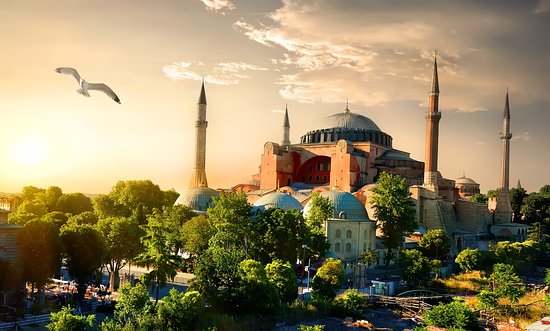 Photo via TripAdvisor (Management)
Some booking links are affiliate links. If you book through them, we may earn a small commission at no extra cost to you. We never let this influence which places we recommend.
Hagia Sophia is an active mosque and one of Istanbul's central architectural and historical monuments. The present building was completed in 537 for Byzantine emperor Justinian I, the third church to stand on the site. Greek mathematician Anthemius of Tralles and geometer-engineer Isidore of Miletus designed an immense basilica crowned by a fully pendentive dome, a structural solution that helped transform later architecture. The nave rises beneath a dome about 32.6 metres across and more than 55 metres above the floor. Forty windows around its base admit light that makes the canopy appear to hover. Half domes and smaller exedrae extend the central space, while marble columns, patterned stone floors, carved surfaces, and mosaics give the interior several layers of Byzantine design. The building's later history is equally visible. Ottoman minarets, buttresses, calligraphic panels, and mosque furnishings coexist with Christian mosaics, including the Virgin and Child in the apse and imperial compositions in the galleries and entrances. Hagia Sophia served as Constantinople's cathedral for almost a millennium, except during the Latin occupation, and became a mosque after the Ottoman conquest in 1453. It was a museum from 1935 until its redesignation as a mosque in 2020. Visitors therefore encounter a functioning religious building whose church, mosque, museum, and conservation histories remain physically intertwined.
Don't miss
- The central pendentive dome, ringed by forty windows and rising more than 55 metres above the nave
- The apse mosaic of the Virgin and Child
- The Imperial Gate mosaic showing an emperor before Christ
- The southwestern entrance mosaic with Constantine and Justinian presenting city and church models
- Ottoman minarets, monumental calligraphy, and mosque additions layered onto the Byzantine basilica
- The marble floor, upper galleries, Imperial Gate, and surviving architectural fragments from earlier phases
Tickets & tours
Ways to visit Hagia Sophia
You can visit on your own (Paid entry for foreign visitors). A tour adds transport and a guide, or combines nearby sights into one day.
 Cheapest way inIstanbul: Hagia Sophia & Blue Mosque Guided & Small-Group Tour4.3★ · 52 travelers~3 hoursFree cancellationFrom$19 per personSee dates →
 Best full dayIstanbul Highlights! Blue Mosque, Hagia Sophia, Topkapı and More4.9★ · 660 travelers8-9 hoursFree cancellationFrom$175 per personSee dates →
 Private & flexibleIstanbul Guided Tour: Hagia Sophia, Basilica Cistern and More!5★ · 64 travelers5-7 hoursFree cancellationFrom$105 per personSee dates →
Getting there
Know before you go
- Hagia Sophia has been an active mosque again since 2020, after serving as a museum from 1935.
- The current structure is the third church built on the site; visible excavated fragments preserve evidence of the earlier Theodosian basilica.
- Christian mosaics and Ottoman Islamic art share the building, and conservation has long sought to protect both layers.
- Earthquakes, dome collapses, and centuries of buttressing and repair are essential to understanding the structure seen today.
A bit of history
The first Great Church on the site was dedicated in 360 and burned during unrest in 404. Theodosius II opened a replacement basilica in 415, but it was destroyed during the Nika Revolt of January 532. Justinian began the present building only weeks later, commissioning Anthemius and Isidore to create a much larger church. It was completed in less than six years and became the cathedral of Constantinople and a defining center of Eastern Orthodox worship. The original dome collapsed after an earthquake in 558. Isidore the Younger rebuilt it higher with forty ribs to reduce outward force, though later earthquakes caused further collapses and repairs. Crusaders converted Hagia Sophia into a Catholic cathedral during the Latin Empire from 1204 to 1261 and removed valuable material during the sack of Constantinople. After Mehmed II conquered the city in 1453, the building became an imperial mosque. Ottoman rulers added minarets, buttresses, a prayer niche, calligraphy, and other elements while covering many figurative mosaics. Gaspare and Giuseppe Fossati restored the structure in the nineteenth century and documented mosaics they found. The secular Turkish Republic closed it in 1931 and reopened it as a museum in 1935. A 2020 court decision annulled its museum status, and Hagia Sophia was redesignated as a mosque, a change that produced strong international debate.
Common questions
When was the present Hagia Sophia built?
Justinian I began it in 532 after the previous church burned in the Nika Revolt, and the new basilica was completed in 537.
Who designed it?
Anthemius of Tralles and Isidore of Miletus, both known for mathematical and engineering expertise, designed the present building.
Why is the dome important?
Its huge canopy rests on four pendentives, an influential solution that transfers a circular dome onto a square base while opening the interior below.
Has Hagia Sophia always been a mosque?
No. It served mainly as an Eastern Orthodox cathedral until 1453, then as a mosque, a museum from 1935, and a mosque again from 2020.
Do Byzantine mosaics survive?
Yes. Important surviving works include the apse Virgin and Child and several imperial mosaics, though many images were lost, covered, or restored over time.
More attractions in Istanbul