Landmark
Casa Batlló
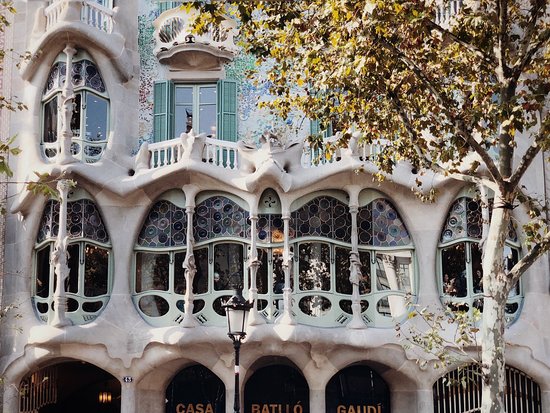 Photo via TripAdvisor
Some booking links are affiliate links. If you book through them, we may earn a small commission at no extra cost to you. We never let this influence which places we recommend.
Casa Batlló is Antoni Gaudí's radical transformation of an existing apartment building on Barcelona's Passeig de Gràcia. The original house was built in 1877 by Emili Sala Cortés, one of Gaudí's architecture professors. Textile industrialist Josep Batlló bought it in 1903 and hired Gaudí the following year, seeking a home that would stand apart from those of other wealthy families on the boulevard. Rather than demolish the structure, Gaudí persuaded Batlló to renovate it. Work finished in 1906 with contributions from assistants Domènec Sugrañes i Gras, Josep Canaleta, and Joan Rubió. The result is part of the Illa de la Discòrdia, the Block of Discord, where neighboring buildings by leading Catalan Modernista architects compete through sharply different styles. Casa Batlló's façade has flowing Montjuïc sandstone, irregular oval windows, bone-like balconies, and a field of broken ceramic mosaic called trencadís. Colors shift from golden orange to green and blue. Above, an arched tiled roof is commonly compared to a dragon's back, while a turret and cross have been interpreted as Saint George's lance. Inside, the enlarged central light well uses graded blue tiles, windows, shutters, and a skylight to distribute light and provide ventilation. The house opened progressively to public visits from 2002, and in 2005 it became part of the UNESCO World Heritage listing for Gaudí's works.
Don't miss
- The trencadís façade, with broken ceramic tiles shifting from warm gold to green and blue
- Skeletal, biomorphic forms behind the local nickname House of Bones
- The dragon-back roof and turret often interpreted through the legend of Saint George
- A blue-tiled light well graded to distribute daylight through the building
- The loft's sixty white catenary arches, resembling an animal ribcage
- The noble floor's curved rooms, tortoise-shell-like skylights, and mushroom-shaped fireplace
Tickets & tours
Ways to visit Casa Batlló
You can see Casa Batlló on your own. A tour is worth it for the story behind it, for transport, or for combining nearby sights into one day.
 Cheapest way inCatamaran Sailing Cruise in Barcelona4.2★ · 55 travelers~1 hourFree cancellationFrom$16 per personSee dates →
 Most bookedCasa Batllo Admission Ticket with Intelligent Audio Guide4.4★ · 3,317 travelers1-2 hoursFrom$52 per personSee dates →
 Private & flexibleBarcelona Essentials Private Tuk-Tuk Tour.4.8★ · 19 travelers1-4 hoursFree cancellationFrom$22 per personSee dates →
Getting there
Know before you go
- Casa Batlló is a remodeled 1877 apartment building, not a structure Gaudí built entirely from the ground up.
- The light well's tiles darken toward the top and lighten below to spread daylight more evenly.
- The dragon-back roof and Saint George's lance form a common interpretation of the design.
- Public access began with the noble floor in 2002 and later expanded to the loft and light well.
A bit of history
The Batlló family's commission emerged from the social rivalry of early twentieth-century Passeig de Gràcia. Josep Puig i Cadafalch had remodeled neighboring Casa Amatller, and Lluís Domènech i Montaner had worked nearby, helping earn the block its nickname. Gaudí submitted his renovation plan in 1904 and completed the house in 1906. He transformed the Batlló family's main apartment, enlarged the central light well, improved ventilation, added floors, and reshaped the exterior. Barcelona's city council nominated the house for its 1906 best-building award, though another project won. The family retained the property after Josep Batlló died in 1934 and his wife died in 1940. An insurance company acquired it in 1954 and adapted rooms for offices. Later restoration campaigns treated interior spaces, balcony colors, the elevator, and the façade. The Bernat family, associated with Chupa Chups, bought Casa Batlló in 1993 and pursued restoration and maintenance. Event use began in 1995. The noble floor opened for public visits in 2002 during the International Year of Gaudí. Restoration of the fifth floor followed, and access expanded to the loft and light well around the centenary of the renovation. The building evolved from a private residence to offices, an event venue, and a museum open to visitors.
Common questions
Did Gaudí build Casa Batlló from scratch?
No. Emili Sala Cortés built the original house in 1877. Gaudí extensively remodeled it for Josep Batlló from 1904 to 1906.
Why is it called the House of Bones?
The local nickname refers to the façade's skeletal, biomorphic forms, especially its curved stonework and bone-like balcony shapes.
What is the Block of Discord?
It is the Passeig de Gràcia block where Casa Batlló stands among dramatically different buildings by major Modernista architects.
How did Gaudí bring light into the house?
He enlarged the central well and used blue tiles with changing intensity, windows, shutters, and a skylight to distribute light and support ventilation.
What was the loft originally used for?
It served tenants as a laundry and storage area. Its sixty catenary arches now form one of the building's most distinctive interiors.
More attractions in Barcelona