Neighborhood
Bairro Alto
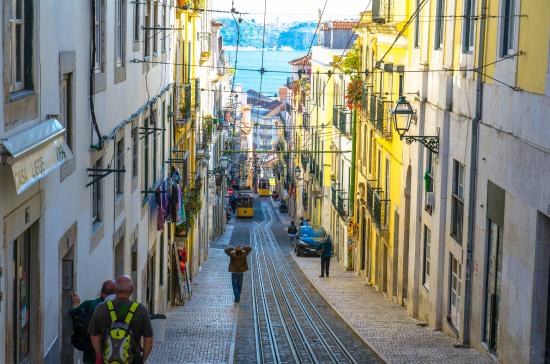 Photo via TripAdvisor (797riccardos)
Some booking links are affiliate links. If you book through them, we may earn a small commission at no extra cost to you. We never let this influence which places we recommend.
Bairro Alto is a central Lisbon district known for its orthogonal street layout and youthful nightlife. The neighborhood is organized into a hierarchy of roads running toward the Tagus River and lanes running parallel to it, creating a homogeneous, intimate urban fabric. Buildings are typically three to four storeys high with asymmetric facades, windows, and lateral staircases, giving the area a distinctive, dense character.
Don't miss
- Orthogonal block layout with rectangular blocks, often two lots wide by six to eight lots long
- Hierarchical street system: structural roads run north–south toward the Tagus, while secondary lanes run east–west
- 16th- and 17th-century buildings with asymmetric facades, small windows, and sills
- Pombaline-era buildings with four storeys, symmetrical facades, central staircases, and mansard roof windows
- Romantic-style palacettes, such as Palacete Laranjeiras, with large verandas and curved lines
- Pedestrian-restricted arteries (since 2002) that preserve the area's intimate character
Tickets & tours
Ways to visit Bairro Alto
You can usually visit on your own. A tour is worth it for transport, a guide, or combining nearby sights into one day.
 Cheapest way inDiscover Bairro Alto's Hidden Gems and Stunning Viewpoints4.9★ · 53 travelers~3 hoursFree cancellationFrom$0 per personSee dates →
 Most bookedAlfama Tour in Lisbon Old Town4.9★ · 5,480 travelers~3 hoursFree cancellationFrom$3 per personSee dates →
 Private & flexiblePrivate Tuk Tuk Tour through Bairro Alto and Chiado5★ · 33 travelers~1 hourFree cancellationFrom$48 per personSee dates →
Know before you go
- Cars are restricted to residents and emergency vehicles, making the district largely pedestrian-friendly.
- The area has no formal local political authority but holds social and historical significance for Lisbon.
A bit of history
The district resulted from urban expansion in the 16th century outside the medieval city walls. The first phase began in 1487 when land was transferred after the death of Guedelha Palaçano, and by 1527 there were 408 buildings with 1600 inhabitants. The second phase started around 1553 with the arrival of the Society of Jesus in São Roque, polarizing growth northward. The 1755 earthquake did not significantly damage Bairro Alto, but later Pombaline-era renovations widened streets and standardized buildings.
Common questions
What does 'Bairro Alto' mean?
It means 'Upper District' in Portuguese.
When did Bairro Alto first develop?
Urbanization began in the late 15th century, with the first phase starting around 1487.
Was Bairro Alto damaged by the 1755 earthquake?
No, the district was not significantly affected by the 1755 Lisbon earthquake.
What architectural styles are common in Bairro Alto?
You'll find 16th- and 17th-century buildings, Pombaline-era structures, and Romantic-style palacettes.
Is Bairro Alto a formal administrative district?
No, it is a loose association of neighborhoods with no formal local political authority.
More attractions in Lisbon