Museum
Anne Frank House
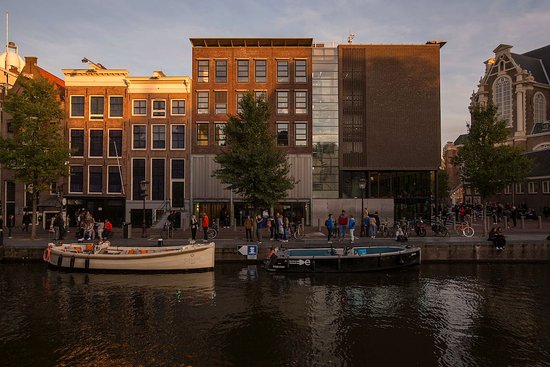 Photo via TripAdvisor (Management)
Some booking links are affiliate links. If you book through them, we may earn a small commission at no extra cost to you. We never let this influence which places we recommend.
The Anne Frank House is a biographical museum and preserved writer's house on Amsterdam's Prinsengracht canal, close to the Westerkerk. Its central space is the Secret Annex, the rear portion of a seventeenth-century canal house where Anne Frank, her parents Otto and Edith, her sister Margot, and four other Jewish people hid from Nazi persecution during the German occupation of the Netherlands. The annex was concealed behind surrounding buildings and offered only about 450 square feet of inhabited rooms. The group remained there for two years and one month before Nazi authorities raided the hiding place, arrested them, and deported them. Otto Frank was the only person from the hidden group to survive the camps. The museum preserves the annex at the rear of Prinsengracht 263 while using adjacent buildings at numbers 265 to 267 for exhibitions about Anne's life, the wartime context, and persecution and discrimination. After the arrests, officers ordered the hiding place cleared, and the remaining clothes, furniture, and personal belongings were seized. Miep Gies and Bep Voskuijl, two of the helpers, rescued books and papers before the building was cleared. Those papers included Anne's diaries, which Otto Frank later prepared for publication. Translations and dramatizations of the diary later made Anne Frank known worldwide.
Don't miss
- The preserved Secret Annex behind Prinsengracht 263
- The concealed relationship between the front offices and rear hiding rooms
- Exhibitions explaining Anne Frank's life, the occupation, persecution, and discrimination
- The building's seventeenth-century canal-house structure and later warehouse use
- Anne's books and papers rescued by Miep Gies and Bep Voskuijl
- The museum complex across numbers 263 to 267, developed to protect the annex and provide historical context
Tickets & tours
Ways to visit Anne Frank House
You can visit Anne Frank House on your own. A guide mainly adds context, what you are looking at and why it matters, and a tour can add transport or combine nearby sights into one day.
 Cheapest way inThe Anne Frank Tour (Jewish Neighborhood & Amsterdam during WWII)4.5★ · 70 travelers~2 hoursFree cancellationFrom$3 per personSee dates →
 Most bookedAmsterdam Classic Saloon Boat Cruise with Drinks and Cheese4.8★ · 33,201 travelers~1 hourFree cancellationFrom$19 per personSee dates →
 Private & flexibleAnne Frank's Amsterdam Jewish History WWII Exclusive Guided Tour5★ · 28 travelers~3 hoursFree cancellationFrom$60 per personSee dates →
Getting there
Know before you go
- The Secret Annex is the preserved hiding place at the rear of Prinsengracht 263; its contents were removed after the arrests.
- The museum spans three adjacent street-front buildings, with the hiding place at the rear of number 263.
- The visit links the rooms to Anne's papers, rescued after the arrests and published in Dutch in 1947.
- The museum developed virtual tours partly because the historic annex creates capacity and accessibility limitations.
A bit of history
The canal house at Prinsengracht 263 was built in 1635 by Dirk van Delft, and its canal façade dates from a 1740 renovation. It later served as a warehouse and various commercial premises. Otto Frank moved the offices of Opekta and Pectacon there in December 1940. The front building contained storage, spice mills, and offices used by employees including Miep Gies, Bep Voskuijl, Johannes Kleiman, and Victor Kugler. The rear annex became the hiding place in 1942. After the raid, officers ordered its contents removed. Gies and Voskuijl recovered Anne's writings, and Otto received them after returning to Amsterdam in June 1945. He combined versions of the diary into the Dutch book Het Achterhuis, published in 1947. Public interest brought early visitors to the rooms, but a clothing company bought the block in 1955 with plans for demolition. A newspaper campaign and public protest helped save number 263. The Anne Frank Foundation was established under Otto Frank's leadership on 3 May 1957 to purchase and restore the property. The owner donated the house, the foundation acquired number 265, and the restored museum opened on 3 May 1960. Later work preserved the annex and the front of number 263, provided educational and functional space at number 265, and added a corner structure for the entrance and visitor facilities.
Common questions
Who hid in the Secret Annex?
Anne Frank hid there with Otto, Edith, and Margot Frank and four other Jewish people seeking refuge from Nazi persecution.
How long did the group remain hidden?
They lived in the annex for two years and one month before the hiding place was raided and they were arrested.
Is the museum the actual hiding place?
Yes. The Secret Annex survives at the rear of Prinsengracht 263, within a larger museum complex using the neighboring buildings.
How were Anne's papers saved?
Miep Gies and Bep Voskuijl returned after the arrests and rescued books and papers before officers had the rooms cleared.
Why was the house nearly demolished?
A clothing manufacturer bought the block in 1955 for redevelopment. A public campaign and the Anne Frank Foundation secured and restored the building.
When did the Anne Frank House open?
The restored building opened as a museum on 3 May 1960, three years after the foundation was created.
More attractions in Amsterdam