Museum
Palazzo Venezia
 ThePhotografer · Wikimedia Commons · CC BY-SA 4.0
Some booking links are affiliate links. If you book through them, we may earn a small commission at no extra cost to you. We never let this influence which places we recommend.
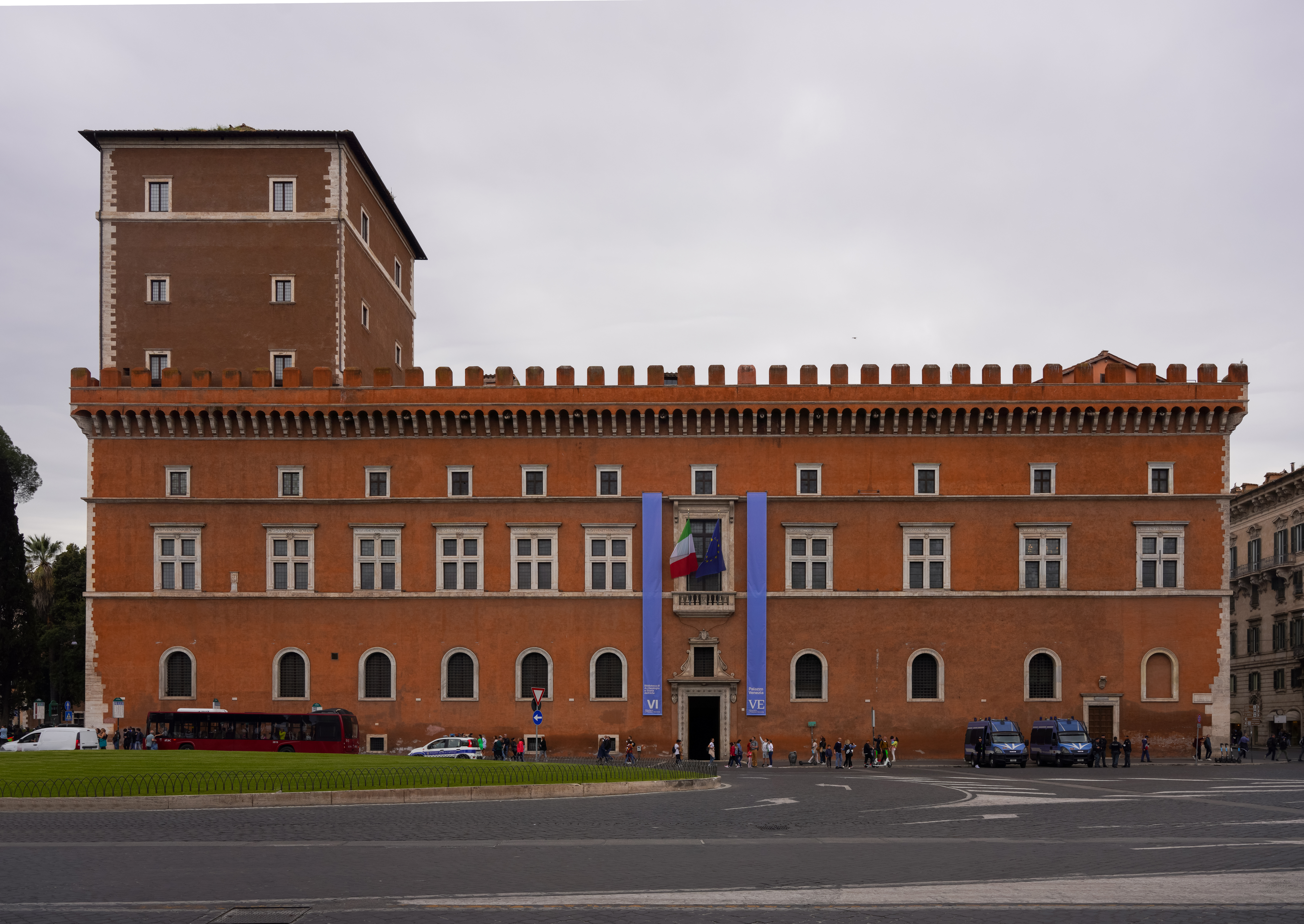
Palazzo Venezia is a large early Renaissance palace in central Rome, north of the Capitoline Hill. It houses the National Museum of the Palazzo Venezia, with galleries of pottery, tapestry, and statuary from the early Christian era to the early Renaissance. The main eastern facade is 77 meters long and about 31 meters high, and the palace covers 1.2 hectares, enclosing two gardens and the Basilica of Saint Mark.
Don't miss
- The main eastern facade, 77 meters long, with a battlemented parapet giving a fortified medieval aspect.
- The Biscia Tower, a large square tower built in 1470 above the south end of the main block.
- The Palazzetto, a three-storied cloister enclosing a garden, originally built between 1466–1469 and later rebuilt 100 meters west.
- The balcony from which Mussolini addressed crowds in Piazza Venezia.
- The Stanza del Pappagallo (Hall of the Parrot), where the Grand Council of Fascism voted to remove Mussolini in 1943.
- The National Museum of the Palazzo Venezia, with collections of pottery, tapestry, and statuary.
Tickets & tours
Ways to visit Palazzo Venezia
You can visit Palazzo Venezia on your own. A guide mainly adds context, what you are looking at and why it matters, and a tour can add transport or combine nearby sights into one day.
 Cheapest way inDa Vinci Museum: Discover a World of Genius in the Heart of Rome4.1★ · 214 travelers1-2 hoursFree cancellationFrom$14 per personSee dates →
 Most bookedRome: Colosseum with Roman Forum & Palatine Hill + Arena Optional4.6★ · 1,430 travelers~3 hoursFrom$35 per personSee dates →
Getting there
Know before you go
- The palace is located north of the Capitoline Hill, facing Piazza Venezia.
- The National Museum of the Palazzo Venezia is housed inside, featuring art from the early Christian era to the early Renaissance.
- In late 2010, an unfinished bunker built for Mussolini was discovered beneath the building.
A bit of history
Built in its present form during the 1450s by Cardinal Pietro Barbo, who later became Pope Paul II. Much of the stone was quarried from the nearby Colosseum. In 1564, Pope Pius IV gave much of the building to the Republic of Venice for its embassy. After 1797, it became the seat of the Austrian ambassador to the Vatican until 1916. In the first half of the 20th century, it was the residence and headquarters of Benito Mussolini, who made notable orations from its balcony. A palace coup in the Stanza del Pappagallo on 24–25 July 1943 ended the Fascist regime.
Common questions
Can I see the balcony where Mussolini spoke?
Yes, the balcony overlooking Piazza Venezia is part of the palace's exterior and is visible from the square.
What is the Biscia Tower?
It is a large square tower built in 1470 above the south end of the main block, possibly named after an ancient sculpture enclosed in the masonry.
Is the Palazzetto still part of the palace?
The original Palazzetto was dismantled in 1910 and rebuilt 100 meters to the west, reusing many original materials.
More attractions in Rome