Museum
Uffizi
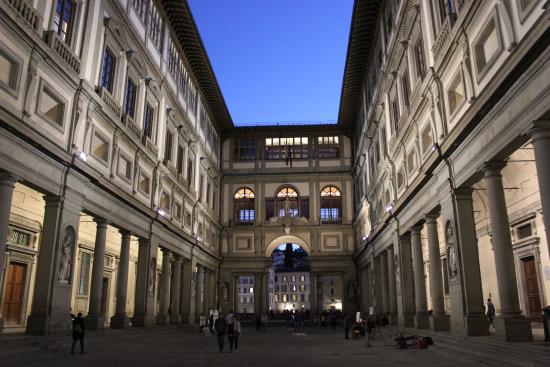 Photo via TripAdvisor (Garfield_the_Tourist)
Some booking links are affiliate links. If you book through them, we may earn a small commission at no extra cost to you. We never let this influence which places we recommend.
The Uffizi Gallery stands beside Piazza della Signoria in Florence's historic center and holds one of the world's best-known collections of Italian Renaissance art. Its name means offices, reflecting the building's original purpose rather than a museum plan. Cosimo I de' Medici commissioned Giorgio Vasari in 1560 to bring Florence's administrative committees, agencies, and guilds together in one complex. Alfonso Parigi and Bernardo Buontalenti continued the work, completed in 1581. The long, narrow internal courtyard opens visually toward the Arno through a Doric screen, and its repeated façades and continuous cornices create a powerful perspective that architectural historians have described as an early regularized European streetscape. The Medici soon used the upper floor to display family art and Roman sculpture. Francesco I commissioned Buontalenti's octagonal Tribuna, completed in 1584 as a concentrated room for masterpieces and precious objects. The gallery gradually expanded through more of the building. Its collections are particularly associated with the Italian Renaissance and include Sandro Botticelli's Primavera and Birth of Venus, both protected by glass during recent protests, along with ancient sculpture such as the Venus de' Medici, Arrotino, Two Wrestlers, and bust of Severus Giovanni. The Uffizi is therefore both a major art collection and a Medici administrative palace whose architecture helped define how elite collections became public museums.
Don't miss
- The long Vasari courtyard and its framed view toward the Arno
- Buontalenti's octagonal Tribuna, an influential room for displaying Medici masterpieces
- Sandro Botticelli's Primavera and Birth of Venus
- Ancient sculpture including the Venus de' Medici, Arrotino, and Two Wrestlers
- The architecture of the original Medici offices beside Piazza della Signoria
- Expanded galleries that bring works formerly kept in storage into public view
Tickets & tours
Ways to visit Uffizi
You can visit Uffizi on your own. A guide mainly adds context, what you are looking at and why it matters, and a tour can add transport or combine nearby sights into one day.
 Cheapest way inThe Best Tour in Florence: Renaissance and Medici Tales4.9★ · 11,718 travelers~2 hoursFree cancellationFrom$3 per personSee dates →
 Most bookedFlorence Accademia Gallery Tour with Entrance Ticket Included4.8★ · 7,675 travelers~1 hourFree cancellationFrom$56 per personSee dates →
 Private & flexibleUFFIZI Private Tour in Florence Italy5★ · 107 travelers~2 hoursFrom$177 per personSee dates →
Getting there
Know before you go
- Advance tickets can significantly reduce long waits during peak periods.
- The museum has remained open through phased modernization, so individual rooms have sometimes closed and works moved temporarily.
- The building began as centralized Medici government offices; the art gallery first occupied its upper floor.
- Works from the Uffizi collection are also available for remote viewing through Google Arts and Culture.
A bit of history
The Medici used the piano nobile for artworks while the lower complex continued to house government offices and the state archive. The Tribuna became a celebrated destination for Grand Tour travelers, demonstrating how a private dynastic display could function as an early museum. Visitors could request access from the sixteenth century. After the ruling Medici line ended, Anna Maria Luisa, the last Medici heiress, secured the family collection for Florence through the Family Pact rather than allowing it to be dispersed. The gallery officially opened to the public in 1769 and formally became a museum in 1865. As the holdings and museum system developed, some works moved to other Florentine institutions, including sculpture transferred to the Bargello. A completed 2006 expansion increased display space from about 6,000 to nearly 13,000 square metres. The long-running New Uffizi project modernized galleries, lighting, climate control, and security while the museum remained open in stages. Florence's 1966 flood damaged museum facilities and photographs. A Mafia car bomb in Via dei Georgofili in 1993 killed five people, destroyed five artworks, damaged thirty more, and severely harmed the Niobe room, later restored. Renovation continued into the twenty-first century, adding fourteen rooms and 129 displayed works in 2021 while seeking broader representation of women and people of color.
Common questions
Why is it called the Uffizi?
The name means offices. Cosimo I commissioned the complex to centralize Florentine administrative bodies and guilds.
Who designed the building?
Giorgio Vasari began it in 1560, and Alfonso Parigi and Bernardo Buontalenti continued the work to completion in 1581.
How did the Medici collection remain in Florence?
Anna Maria Luisa, the last Medici heiress, transferred the family collections to the city through the Family Pact.
When did it become a public museum?
Visitors could request access from the sixteenth century, the gallery officially opened to the public in 1769, and it formally became a museum in 1865.
What is the Tribuna?
It is Buontalenti's octagonal 1584 room, created to display a concentrated group of Medici masterpieces and precious objects.
More attractions in Florence