Religious site
Santa Croce, Florence
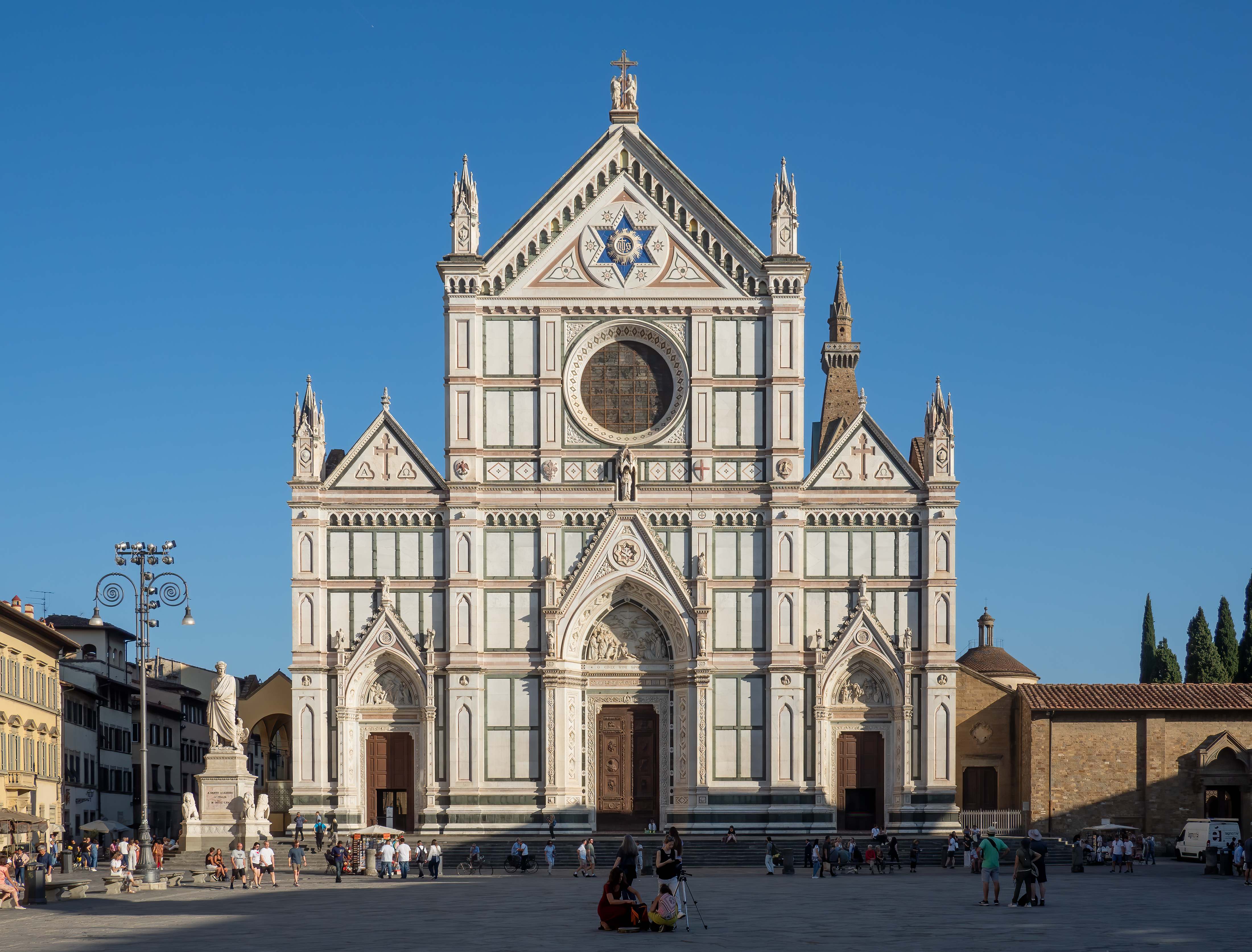 Rhododendrites · Wikimedia Commons · CC BY-SA 4.0
Some booking links are affiliate links. If you book through them, we may earn a small commission at no extra cost to you. We never let this influence which places we recommend.
Santa Croce is a Franciscan minor basilica in Florence, located on Piazza di Santa Croce, about 800 meters southeast of the Duomo on former marshland beyond the old city walls. It serves as the burial place of many notable Italians, including Michelangelo, Galileo, and Machiavelli, earning it the nickname 'Temple of the Italian Glories.' As the largest Franciscan church in the world, its design reflects the austere Franciscan approach, with a floorplan shaped like a Tau cross, 115 meters long, featuring a nave and two aisles separated by octagonal columns.
Don't miss
- Sixteen chapels decorated with frescoes by Giotto and his pupils, including the Bardi Chapel with scenes of the Life of St Francis and the Peruzzi Chapel.
- Tombs and cenotaphs of famous Italians such as Michelangelo, Galileo, Machiavelli, Rossini, and Dante (though Dante is buried in Ravenna).
- The Primo Chiostro (main cloister) housing the Cappella dei Pazzi, designed with input from Filippo Brunelleschi, completed in the 1470s.
- The Museo dell'Opera di Santa Croce, located in the refectory off the cloister, displaying artworks including Cimabue's Crucifix damaged in the 1966 flood.
- Stained-glass windows from the late 13th and 14th centuries, among the earliest in Florence, found in the transept chapels and high altar chapel.
Tickets & tours
Ways to visit Santa Croce, Florence
You can visit Santa Croce, Florence on your own. A guide is worth it for the history and detail that is easy to walk past, and a tour can combine it with nearby sights.
 Cheapest way inThe Best Tour in Florence: Renaissance and Medici Tales4.9★ · 11,727 travelers~2 hoursFree cancellationFrom$3 per personSee dates →
 Most bookedThe Best tour in Florence: Renaissance & Medici Tales - guided by a STORYTELLER5★ · 13,460 travelers~2 hoursFree cancellationFrom$3 per personSee dates →
 Private & flexibleFlorence SANTA CROCE Basilica Private Tour5★ · 20 travelers~1 hourFree cancellationFrom$103 per personSee dates →
Getting there
Know before you go
- The basilica is a minor basilica and the principal Franciscan church of Florence, situated on Piazza di Santa Croce.
- Many frescoes, such as those by Giotto in the Bardi and Peruzzi chapels, were restored after being plastered over or damaged; some areas remain missing where altars were attached.
- The Jewish architect Niccolò Matas, who designed the façade, is buried under the threshold with an inscription because he was Jewish.
A bit of history
Construction of the current church began on 12 May 1294, possibly by Arnolfo di Cambio, funded by wealthy Florentine families, and it was consecrated in 1442 by Pope Eugene IV. In 1560, the choir screen was removed during Counter-Reformation changes, and Giorgio Vasari rebuilt the interior, damaging some frescoes. The neo-Gothic marble façade, designed by Jewish architect Niccolò Matas, was added between 1857 and 1863, featuring a prominent Star of David. In 1966, the Arno River flood severely damaged the church, bringing mud and heating oil, which took decades to repair.
Common questions
Who is buried in Santa Croce?
Notable figures buried or commemorated include Michelangelo, Galileo, Machiavelli, Rossini, Foscolo, and Gentile, as well as commemorative plaques for Leonardo da Vinci and Enrico Fermi.
What famous artworks are inside the basilica?
Key artworks include Giotto's frescoes in the Peruzzi and Bardi chapels, Donatello's Cavalcanti Annunciation and crucifix, Cimabue's Crucifix (now in the refectory), and stained-glass windows from the 13th and 14th centuries.
Why is the church called the Temple of the Italian Glories?
It earned this nickname because it is the burial place of many illustrious Italians from the Renaissance and later periods, including Michelangelo, Galileo, and Machiavelli.
What happened during the 1966 flood?
The Arno River flooded the church, bringing mud, pollution, and heating oil, causing severe damage to buildings and art that took decades to repair.
More attractions in Florence