Landmark
Ponte Vecchio
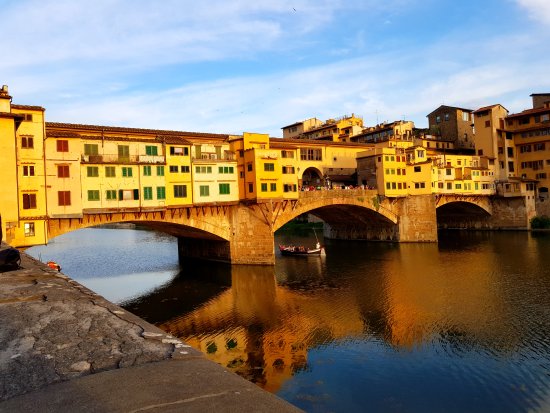 Photo via TripAdvisor (docboy)
Some booking links are affiliate links. If you book through them, we may earn a small commission at no extra cost to you. We never let this influence which places we recommend.
The Ponte Vecchio is a medieval stone bridge over the Arno River in Florence, Italy. It is the only bridge in Florence that survived World War II without being destroyed. The bridge is famous for the shops built along it, which were once occupied by butchers, tanners, and farmers, but today house jewellers, art dealers, and souvenir sellers. Despite being closed to vehicular traffic, it sees heavy pedestrian flow because it connects major tourist sites like Piazza del Duomo and Piazza della Signoria on one side with Palazzo Pitti and Santo Spirito on the other.
Don't miss
- The three segmental arches: the main arch spans 30 meters, and the two side arches each span 27 meters, with a shallow rise that allowed easy access for carts.
- A large piazza at the center of the bridge, described by Leon Battista Alberti as a prominent ornament in the city.
- A bronze bust of Benvenuto Cellini, created in 1900 by Raffaello Romanelli, standing atop a fountain on the eastern side of the bridge.
- A weathered dedication stone in a loggia at the central opening, which once recorded the bridge's rebuilding after the 1333 flood.
- A stone with an inscription from Dante marking the spot where Buondelmonte de' Buondelmonti was murdered in 1215, sparking Guelf and Ghibelline fighting.
- The back shops (retrobotteghe) visible from upriver, added in the 17th century.
Tickets & tours
Ways to visit Ponte Vecchio
You can see Ponte Vecchio on your own. A tour is worth it for the story behind it, for transport, or for combining nearby sights into one day.
 Cheapest way inThe Best Tour in Florence: Renaissance and Medici Tales4.9★ · 11,727 travelers~2 hoursFree cancellationFrom$3 per personSee dates →
 Most bookedFlorence River Cruise on a Traditional Barchetto4.3★ · 400 travelers~1 hourFree cancellationFrom$65 per personSee dates →
 Private & flexiblePALAZZO VECCHIO Private tour in Florence5★ · 37 travelers~2 hoursFree cancellationFrom$140 per personSee dates →
Getting there
Know before you go
- Shops on the bridge are exclusively goldsmiths, jewellers, and art dealers, a tradition dating back to a 1565 decree.
- The bridge was severely damaged in the 1966 flood of the Arno.
A bit of history
The bridge spans the Arno at its narrowest point, where a bridge likely first existed in Roman times when the Via Cassia crossed the river. It first appears in a document from 996 and was destroyed by a flood in 1117, then rebuilt in stone. After another flood in 1333, it was rebuilt around 1339–1345. In 1565, Cosimo I de' Medici had Giorgio Vasari build the Vasari Corridor, part of which runs above the bridge. A decree in 1565 excluded butchers from the bridge, allowing only goldsmiths and jewellers, a rule still in effect today.
Common questions
Why is the Ponte Vecchio called the 'Old Bridge'?
It was given that name when the Ponte alla Carraia was built and called 'Ponte Nuovo' (New Bridge), making this the older structure.
Was the Ponte Vecchio destroyed in World War II?
No, it was the only bridge in Florence spared from destruction during the war, though the buildings at both ends were demolished to block access.
What kind of shops are on the bridge today?
The shops are now occupied by jewellers, art dealers, and souvenir sellers, following a 1565 decree that banned butchers and allowed only goldsmiths and jewellers.
Is there a famous artwork on the bridge?
Yes, a bronze bust of the Florentine goldsmith and sculptor Benvenuto Cellini, created in 1900, stands on a fountain in the middle of the eastern side.
Can you drive across the Ponte Vecchio?
No, the bridge is closed to vehicular traffic and is only used by pedestrians.
More attractions in Florence