Landmark · Mehrauli/Qutub Minar
Qutub Minar
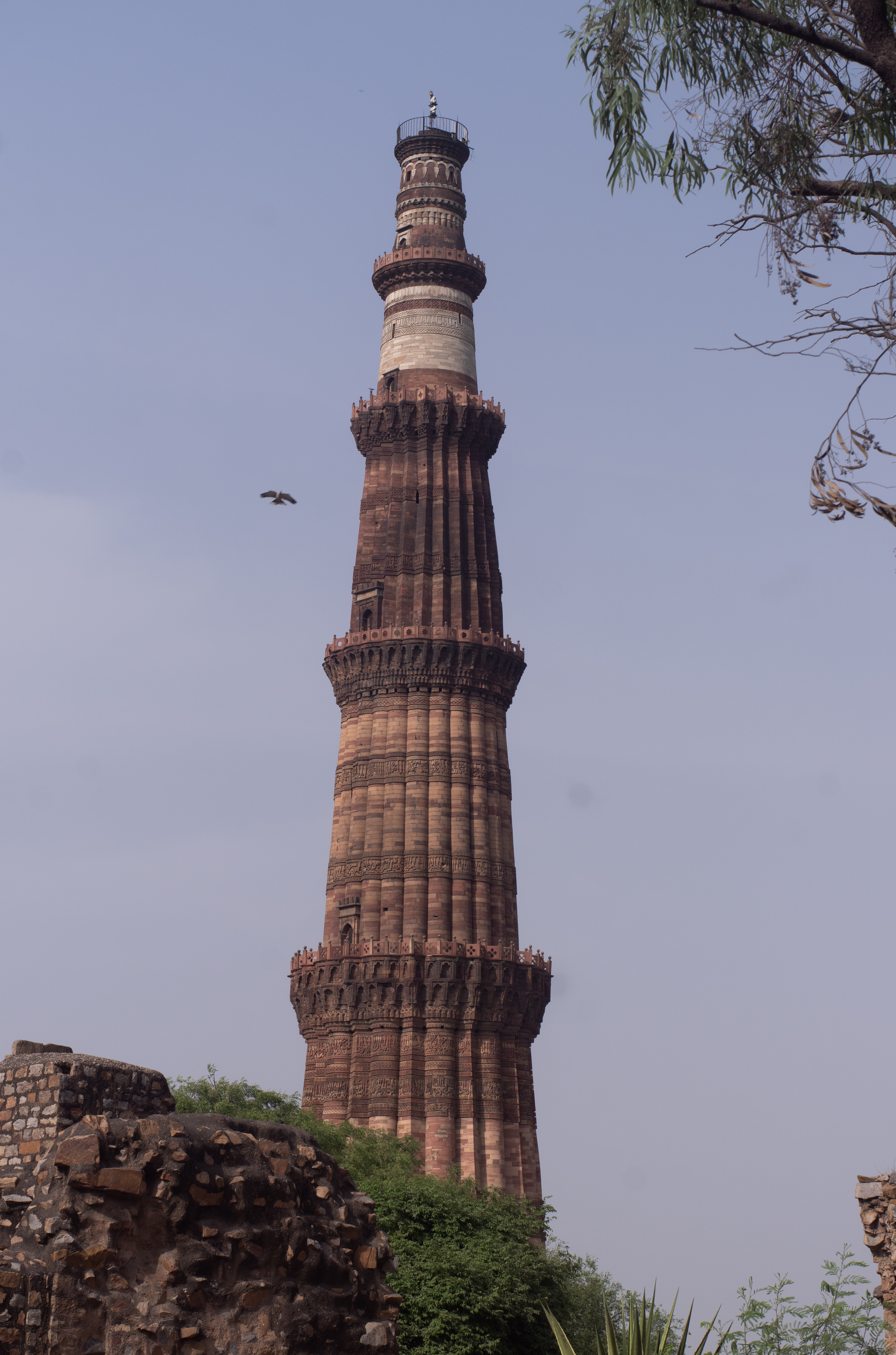 Wasir kasab · Wikimedia Commons · CC BY 4.0
Some booking links are affiliate links. If you book through them, we may earn a small commission at no extra cost to you. We never let this influence which places we recommend.
The Qutub Minar is a soaring 73-metre victory tower in Delhi, the tallest brick minaret in the world and the centrepiece of a UNESCO-listed complex of early Indo-Islamic architecture. Built in red sandstone and marble, its five tapering, intricately carved tiers are banded with Arabic inscriptions and balconies. Around it lie the ruins of one of India's earliest mosques, ornate gateways, and the famous Iron Pillar, a 1,600-year-old column that has barely rusted, a metallurgical mystery that still puzzles scientists.
The complex is leafy and atmospheric, especially in the late-afternoon light when the sandstone glows. You can no longer climb the minaret itself, but wandering the surrounding ruins, carved colonnades, and tombs makes for a rewarding hour or two among some of Delhi's oldest monuments.
Don't miss
- The 73m carved sandstone victory tower
- The 1,600-year-old rust-resistant Iron Pillar
- The ruins of the Quwwat-ul-Islam, an early Indian mosque
- Carved gateways and colonnades reusing older temple stone
- Late-afternoon light on the red sandstone
Tickets & tours
Ways to visit Qutub Minar
You can visit on your own (paid entry, with separate rates often applying for indian and foreign visitors; tickets available online or at the gate). A tour adds transport and a guide, or combines nearby sights into one day.
 Cheapest way inNew Delhi and Old Delhi Tour Full Day5★ · 136 travelers4–8 hoursFree cancellationFrom$10 per personSee dates →
 Best full dayDelhi: Old and New Delhi Guided Full or Half-Day Tour4.9★ · 1,062 travelers4–8 hoursFree cancellationFrom$20 per personSee dates →
 Private & flexibleExclusive New Delhi City Tour5★ · 19 travelers4–5 hoursFree cancellationFrom$40 per personSee dates →
Good for
How travelers rate it
Know before you go
- You can't climb the minaret, access was closed long ago, but the surrounding ruins are the real reward.
- Late afternoon gives the best light on the red sandstone and cooler walking.
- Look for the Iron Pillar and the reused temple carvings in the mosque colonnade.
- Carry water and sun protection; shade is limited in parts.
A bit of history
Begun in 1192 by Qutb-ud-din Aibak, founder of the Delhi Sultanate, to mark the advent of Muslim rule, the minaret was completed and extended by his successors. The surrounding Quwwat-ul-Islam mosque reused carved stone from earlier Hindu and Jain temples, visible in its pillars. The site became a UNESCO World Heritage Site in 1993.
Common questions
Can I climb the Qutub Minar?
No, climbing the tower has been closed to the public for decades. You admire it from the grounds and explore the surrounding ruins.
What's the Iron Pillar?
A roughly 1,600-year-old iron column in the complex that has resisted rust for centuries, a metallurgical puzzle that still draws scientific interest.
How long should I spend?
About an hour to 90 minutes to take in the minaret, the mosque ruins, and the gateways.
When's the best time to visit?
Late afternoon for golden light and cooler air, or early morning for fewer crowds. Avoid peak midday heat in summer.
More attractions in New Delhi