Landmark
Brandenburg Gate
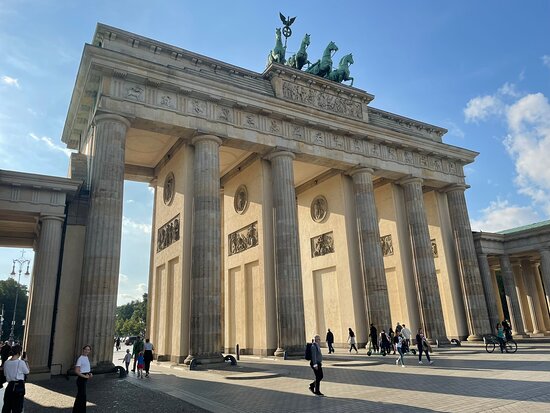 Photo via TripAdvisor (Vicent_Mestre)
Some booking links are affiliate links. If you book through them, we may earn a small commission at no extra cost to you. We never let this influence which places we recommend.
The Brandenburg Gate is an eighteenth-century Neoclassical monument at the western end of central Berlin's Unter den Linden. It faces Pariser Platz to the east and opens west toward Platz des 18. März and the Straße des 17. Juni, with the Reichstag one block north and the Tiergarten beyond. King Frederick William II of Prussia commissioned the present structure, built from 1788 to 1791 by royal architect Carl Gotthard Langhans on the site of an earlier customs-wall gate. Langhans modeled its monumental front on the Propylaea of the Athenian Acropolis, making it an early major work of Greek Revival architecture in Germany. Twelve fluted Doric columns create five passageways, while reliefs include the Labours of Hercules and scenes from Greek mythology. L-shaped wings once functioned as custom houses. Above the gate, Johann Gottfried Schadow's copper-sheet quadriga shows a four-horse chariot. Its driver was first conceived as the peace goddess Eirene, then reinterpreted after the Napoleonic Wars as Victoria bearing the Iron Cross and Prussian eagle. The monument's meaning has shifted repeatedly. It served Prussian ceremony, survived war damage, stood sealed beside the Berlin Wall, and reopened as the city reunited. Since German reunification, it has become a national symbol of the country's difficult history as well as European unity and peace.
Don't miss
- Twelve Doric columns forming five passageways modeled on Athens's Propylaea
- Schadow's four-horse quadriga above the gate
- Reliefs of the Labours of Hercules and other Greek mythological scenes
- The eastward view along Unter den Linden and westward view toward Tiergarten
- The gate's Cold War position, where the Berlin Wall ran directly beside its western side
- Pariser Platz and the nearby Reichstag, central to the gate's modern civic setting
Tickets & tours
Ways to visit Brandenburg Gate
You can see Brandenburg Gate on your own. A tour is worth it for the story behind it, for transport, or for combining nearby sights into one day.
 Cheapest way inBerlin Wall: Greatest Escapes Self-Guided Walking Adventure4.2★ · 29 travelers~2 hoursFree cancellationFrom$7 per personSee dates →
 Most bookedDiscover Berlin Half-Day Walking Tour4.9★ · 10,055 travelers~4 hoursFree cancellationFrom$21 per personSee dates →
 Private & flexiblePrivate Walking Tour: World War 2 and Cold War Sites in Berlin5★ · 244 travelers3-4 hoursFree cancellationFrom$191 per personSee dates →
Getting there
Know before you go
- The gate is closed to vehicle traffic and much of Pariser Platz is a cobblestone pedestrian area.
- The quadriga faces east toward the historic city center, as it did when first installed.
- The Reichstag is one block north, while Tiergarten begins to the west beyond Platz des 18. März.
- The Berlin Wall ran directly beside the gate from 1961 until the crossing reopened in December 1989.
A bit of history
A smaller Baroque gate preceded the present monument on the road to Brandenburg an der Havel. Frederick William II sought to make Berlin a stronger cultural capital and appointed Langhans, whose gate opened to traffic in 1791 as the Peace Gate. Napoleon used it for a triumphal procession after defeating Prussia in 1806 and removed the quadriga to Paris. Prussian forces returned the sculpture after Napoleon's defeat in 1814, and Karl Friedrich Schinkel adapted its emblems to make the gate a Prussian triumphal arch. The structure later witnessed revolutionary violence, Nazi political use, and wartime destruction. It remained standing in the ruins of Pariser Platz in 1945, though columns and the quadriga were badly damaged. East and West Berlin cooperated on restoration from 1956 to 1957, recreating the quadriga from a surviving plaster cast. When the Berlin Wall was built in August 1961, it passed directly beside the western side and closed the gate to ordinary movement. The monument became an image of the divided city. Crowds celebrated nearby as the wall fell in November 1989. On 22 December, the crossing reopened when West German chancellor Helmut Kohl walked through to meet East German prime minister Hans Modrow. The wall around it was removed, Germany reunified in 1990, and the restored gate became a pedestrian monument and major public gathering place.
Common questions
When was the Brandenburg Gate built?
Carl Gotthard Langhans designed the present gate for Frederick William II, and it was built from 1788 to 1791.
What inspired its design?
Its Greek Revival form draws on the Propylaea, the monumental gateway to the Acropolis in Athens.
What is the sculpture on top?
Johann Gottfried Schadow's quadriga is a four-horse chariot whose goddess figure changed in meaning from peace to Prussian victory.
What happened to the gate during the Cold War?
The Berlin Wall passed directly beside it, closing the gateway from August 1961 until the crossing reopened on 22 December 1989.
Did the quadriga always remain in Berlin?
No. Napoleon took it to Paris after Prussia's 1806 defeat, and it returned after Napoleon was defeated in 1814.
More attractions in Berlin