Sight
Pyramid of Menkaure
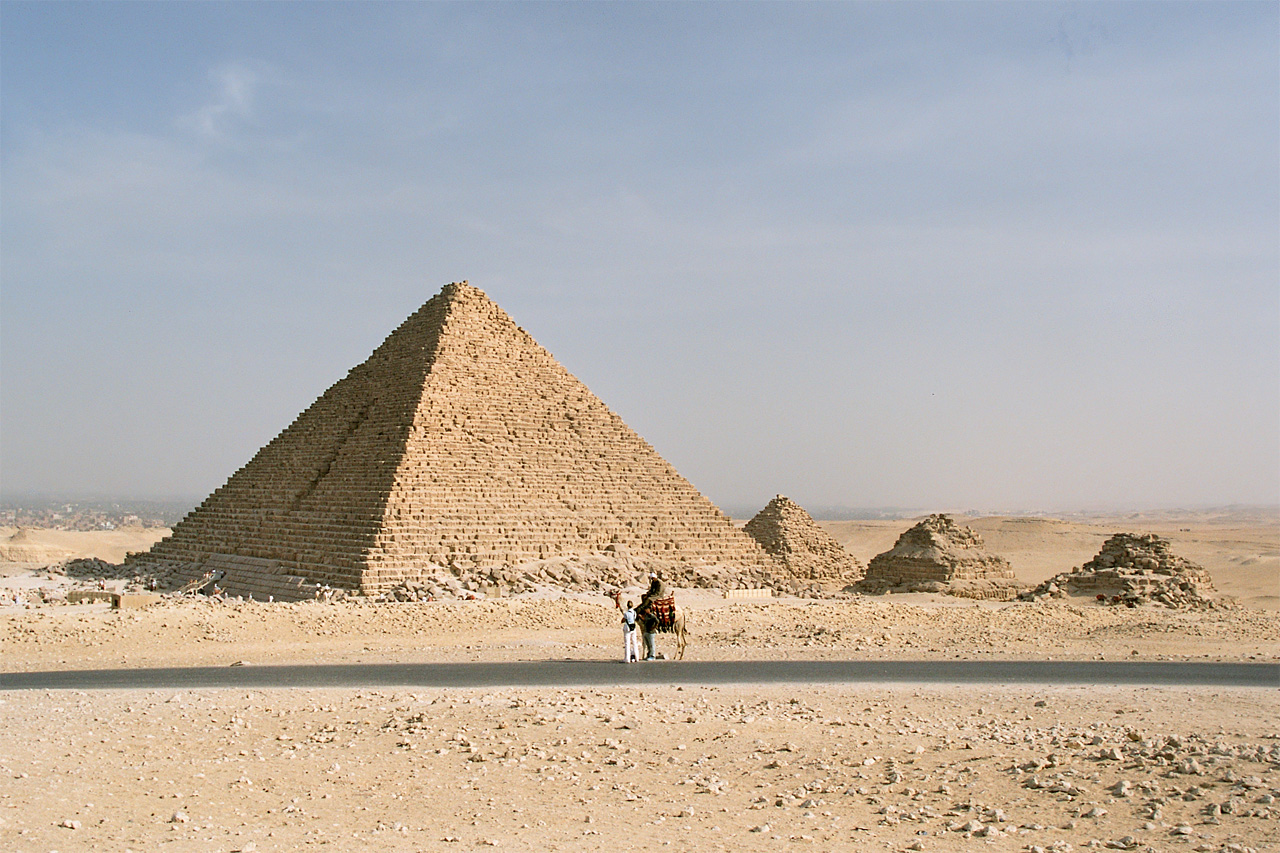 Wikimedia Commons · CC BY-SA 2.5
Some booking links are affiliate links. If you book through them, we may earn a small commission at no extra cost to you. We never let this influence which places we recommend.
The Pyramid of Menkaure is the smallest of the three main pyramids on the Giza Plateau, located southwest of Cairo. It was built as the tomb of Fourth Dynasty King Menkaure and originally stood 65.5 meters tall, now reaching 61 meters with a base of 108.5 meters. Its construction used limestone and Aswan granite, with an incline of about 51°20′25″. Along its south flank are three smaller pyramids associated with the complex.
Don't miss
- Notice the remaining seven layers of granite casing on the upper portion, originally planned to be sixteen to eighteen layers thick.
- Look for the large vertical gash on the northern face, a remnant of the 1196 demolition attempt.
- Observe the three smaller queens' pyramids (G3-a, G3-b, G3-c) south of the main pyramid, one of which once contained a pink granite sarcophagus.
- Examine the mortuary temple on the east flank, where some limestone blocks weigh up to 220 tons and granite ashlars from Aswan exceed 30 tons.
- Look for the smoothed area on the eastern face, where 2019 scans revealed air-filled voids that may indicate a hidden second entrance.
Tickets & tours
Ways to visit Pyramid of Menkaure
You can usually visit on your own. A tour is worth it for transport, a guide, or combining nearby sights into one day.
 Cheapest way inPyramids & grand Egyptian Museum(gym)5★ · 17 travelers6-7 hoursFree cancellationFrom$5 per personSee dates →
 Best full dayTop : 5 Hours Day Tour Pyramid Sakkara Pyramid Memphis City4.9★ · 456 travelers6-8 hoursFree cancellationFrom$10 per personSee dates →
 Private & flexiblePyramids Sphinx Grand Egyptian Museum & Bazaar Or Nile Felucca5★ · 229 travelers8-10 hoursFree cancellationFrom$8 per personSee dates →
Getting there
Know before you go
- The outer casing combined Tura limestone with Aswan granite; only seven of the planned sixteen to eighteen granite layers remain.
- A large vertical gash on the northern face records an unsuccessful eight-month demolition attempt begun in 1196.
- A boat hieroglyph painted on a nearby limestone block may indicate that the complex once had a boat pit for a solar barque.
A bit of history
The pyramid was likely completed in the 26th century BC, though Menkaure's exact reign is unknown. It was probably robbed as early as the First Intermediate Period. In 1837, Howard Vyse and John Shae Perring discovered a basalt sarcophagus containing a young woman's bones, but it was lost at sea off Spain. A wooden coffin with Menkaure's name was found in the upper burial chamber and is now in the British Museum. In 1196, Sultan Al-Aziz Uthman attempted to demolish the pyramid, but workers only left a large vertical gash on its northern face after eight months. A 2024 restoration project was cancelled after experts objected to reinstalling fallen granite casing blocks.
Common questions
Why is Menkaure's pyramid smaller than the other two?
It was built for King Menkaure, the son and successor of Khafre, and is the smallest of the three main pyramids at Giza, originally 65.5 meters tall.
What happened to Menkaure's sarcophagus?
The basalt sarcophagus was discovered in 1837 but was lost when the ship carrying it wrecked off the Spanish coast on its way to Britain.
What are the three small pyramids south of Menkaure?
They are designated G3-a, G3-b, and G3-c, likely tombs for Menkaure's queens or possibly a ka pyramid and a mummification chapel.
Was the pyramid ever damaged on purpose?
In 1196, Sultan Al-Aziz Uthman tried to demolish it, but workers only managed to create a large vertical gash on the northern face after eight months.
More attractions in Giza