Neighborhood
Wenceslas Square
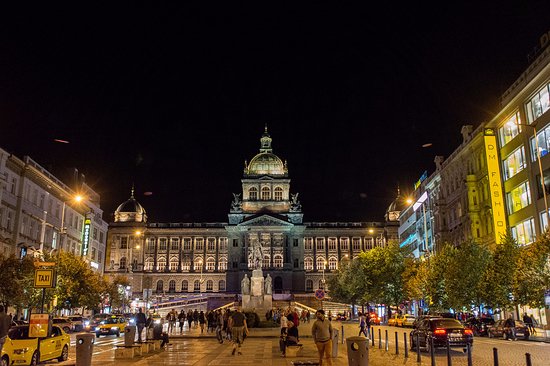 Photo via TripAdvisor (Discover656889)
Some booking links are affiliate links. If you book through them, we may earn a small commission at no extra cost to you. We never let this influence which places we recommend.
Wenceslas Square is a long, boulevard-like square in Prague's New Town, serving as the city's main commercial and cultural hub. It is a traditional site for public gatherings, celebrations, and demonstrations, and is part of the historic center, a UNESCO World Heritage Site. The square is dominated at its southeast end by the grand neoclassical National Museum and a statue of Saint Wenceslas.
Don't miss
- The National Museum building (1885–1891) at the southeast end, designed by Josef Schulz
- The statue of Saint Wenceslas, a gathering point of national significance
- Architectural landmarks like Palác Koruna, the Lindt Building, and Hotel Evropa
- The BAŤA shoe store (1929) and the Peterka Building (1899–1900)
- The Melantrich Building, where Alexander Dubček and Václav Havel appeared during the Velvet Revolution
Tickets & tours
Ways to visit Wenceslas Square
You can usually visit on your own. A tour is worth it for transport, a guide, or combining nearby sights into one day.
 Cheapest way inPrague Essential Tour Old Town and Jewish Quarter5★ · 549 travelers~3 hoursFree cancellationFrom$3 per personSee dates →
 Most bookedPrague Old Town, Medieval Underground and Dungeon Historical Tour4.7★ · 4,830 travelers~2 hoursFree cancellationFrom$31 per personSee dates →
 Private & flexiblePrague's Jewish Quarter Private Tour4.9★ · 52 travelers~3 hoursFree cancellationFrom$169 per personSee dates →
Getting there
Know before you go
- The square is served by Metro line A, with stations Muzeum (lines A and C) and Můstek (lines A and B) having entrances on the street.
- The northwestern end of the square has been pedestrianised since 2012, making it easier to walk.
- Christmas markets are held here annually from early December to the first week of January.
A bit of history
Founded in 1348 by King Charles IV as the Horse Market (Koňský trh), it was one of several market areas in the New Town. Renamed Saint Wenceslas Square in 1848, it has been the site of key historical events: the reading of the Czechoslovak declaration of independence in 1918, protests during the 1938 May Crisis, Jan Palach's self-immolation in 1969, and large demonstrations during the 1989 Velvet Revolution.
Common questions
What is the nickname for Wenceslas Square?
It is colloquially called Václavák, and historically was known as the Horse Market (Koňský trh).
Why is the square named after Saint Wenceslas?
It was renamed in 1848 to honor Saint Wenceslas, the patron saint of Bohemia, following a proposal by Karel Havlíček Borovský.
What major events have taken place here?
The square was the site of the 1918 declaration of independence, 1969 protests after Jan Palach's self-immolation, and the 1989 Velvet Revolution demonstrations.
More attractions in Prague