Landmark
Prague astronomical clock
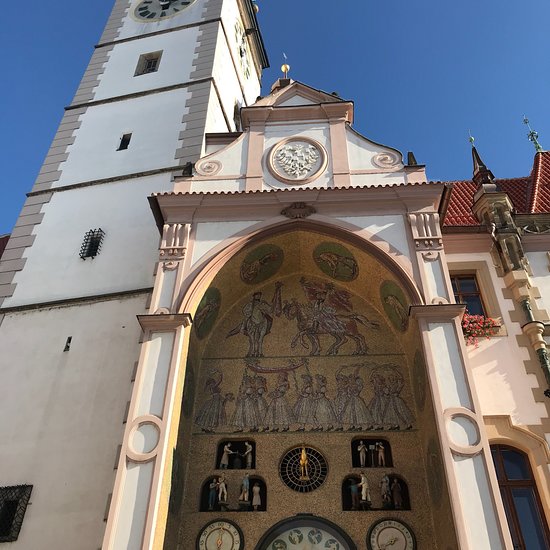 Photo via TripAdvisor (NYCJuly)
Some booking links are affiliate links. If you book through them, we may earn a small commission at no extra cost to you. We never let this influence which places we recommend.
The Prague astronomical clock, or Orloj, is a medieval astronomical clock on the southern wall of the Old Town Hall in Prague's Old Town Square. It has three main parts: the astronomical dial showing the Sun and Moon's positions, a calendar dial with medallions for the months, and an hourly show of moving Apostle figures and other sculptures, including a skeleton representing Death striking the time.
Don't miss
- The astronomical dial, a mechanical astrolabe showing the Sun and Moon's positions and the zodiac
- The hourly 'Walk of the Apostles' with moving statues of the Twelve Apostles appearing above the clock
- Four figures flanking the clock: Vanity (admiring himself), Greed (holding a bag of gold), Death (a skeleton striking the time), and a Turkish figure representing lust
- The calendar dial below the clock, with medallions representing the months and allegories of the months
- The golden Sun and half-silvered, half-black Moon that show lunar phases, powered only by gravity
Tickets & tours
Ways to visit Prague astronomical clock
You can see Prague astronomical clock on your own. A tour is worth it for the story behind it, for transport, or for combining nearby sights into one day.
 Cheapest way inClassic Prague Castle Tour, Strahov Monastery & Castle District4.9★ · 222 travelers~3 hoursFree cancellationFrom$3 per personSee dates →
 Most bookedPrague Old Town, Medieval Underground and Dungeon Historical Tour4.7★ · 4,830 travelers~2 hoursFree cancellationFrom$31 per personSee dates →
 Private & flexibleThe Astronomer's Legacy: Prague Self Guided Mystery Game4.8★ · 18 travelers~3 hoursFree cancellationFrom$45 per personSee dates →
Getting there
Know before you go
- The clock is mounted on the southern wall of the Old Town Hall in the Old Town Square.
- On the hour, the four flanking figures move: Vanity, Greed, Death rings the bell, and the Turkish figure shakes its head.
- The astronomical dial uses golden Roman numerals for local Prague time and curved golden lines for unequal 'hours' that vary with sunrise and sunset.
A bit of history
The oldest part, the mechanical clock and astronomical dial, dates to 1410, created by horologist Mikuláš of Kadaň and professor Jan Šindel. The calendar dial and Gothic sculptures were added around 1490. A legend says the clockmaker Hanuš was blinded so he couldn't repeat his work, and he disabled the clock in revenge. The clock was damaged in May 1945 during the Prague uprising when Nazis fired on the square, but was repaired and working again by 1948. It was renovated in 2005 and again from January to September 2018, when an electric mechanism was replaced with an original 1860s mechanism.
Common questions
What do the four figures flanking the clock represent?
From left to right: Vanity (admiring himself in a mirror), Greed or usury (holding a bag of gold), Death (a skeleton striking the time), and a Turkish figure representing lust and earthly pleasures.
When do the Apostles appear?
Every hour of the day, statues of the Twelve Apostles appear at the doorways above the clock, with the left and right windows sliding aside to reveal them.
What happened to the clock in 1945?
On 7 and 8 May 1945, during the Prague uprising, Nazis fired on the square, damaging the clock. The hall and wooden sculptures burned, but the machinery was repaired and the clock started working again in 1948.
More attractions in Prague