Landmark
La Moneda Palace
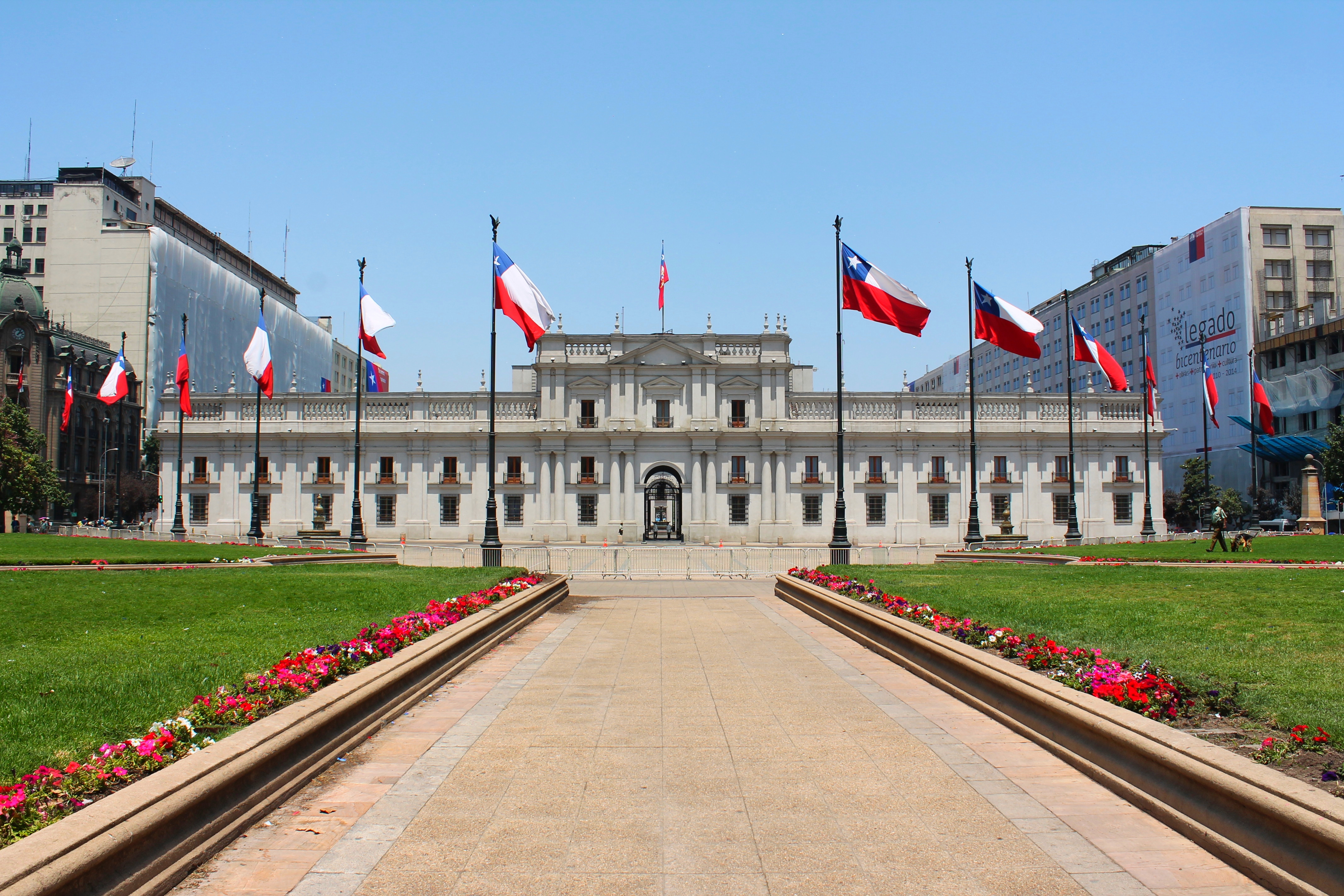 Miguel hernandez · Wikimedia Commons · CC BY-SA 2.0
Some booking links are affiliate links. If you book through them, we may earn a small commission at no extra cost to you. We never let this influence which places we recommend.
La Moneda Palace is the seat of the president of Chile, located in downtown Santiago. It occupies an entire block in the Civic District, bordered by Moneda, Morandé, Alameda, and Teatinos streets. The neoclassical building, originally the colonial mint, now houses the offices of three cabinet ministers. Visitors can see the palace's white facade, inner courtyards open to the public during certain hours, and the Plaza de la Ciudadanía on its south side.
Don't miss
- Plaza de la Constitución in front of the palace, built in 1930
- Plaza de la Ciudadanía on the south side, inaugurated in 2005, with paths to the underground Palacio de La Moneda Cultural Center
- Patio de los Naranjos, where presidential ceremonies take place
- Morandé 80 gate, historically used by presidents to enter as ordinary citizens
- Preserved bullet marks from the 1973 coup
- Traditional changing of the guard ceremony every two days at 10 a.m. weekdays and 11 a.m. weekends, lasting about 30 minutes
Tickets & tours
Ways to visit La Moneda Palace
You can see La Moneda Palace on your own. A tour is worth it for the story behind it, for transport, or for combining nearby sights into one day.
 Cheapest way inOfficial Tour of the Metropolitan Cathedral of Santiago5★ · 589 travelers~1 hourFree cancellationFrom$11 per personSee dates →
 Most bookedCable Car, Funicular and Sightseeing Bus in Santiago one day4.9★ · 2,731 travelers~2 hoursFree cancellationFrom$67 per personSee dates →
 Private & flexiblePort of San Antonio4.3★ · 20 travelers~2 hoursFree cancellationFrom$120 per personSee dates →
Getting there
Know before you go
- The palace is located in downtown Santiago, occupying a full block bordered by Moneda, Morandé, Alameda, and Teatinos streets.
- Inner courtyards are open to the public during certain hours of the day.
- The changing of the guard occurs every two days on odd-numbered days in odd-numbered months, even-numbered days in even-numbered months, including Sundays, at 10 a.m. weekdays and 11 a.m. weekends.
A bit of history
La Moneda was designed by Italian architect Joaquín Toesca and opened in 1805 as the royal mint. It produced coins from 1814 to 1929. In 1845, it became the seat of government and presidential residence. During the 1973 military coup, the palace was strafed by the Chilean Air Force, and President Salvador Allende died there. Restoration was completed in 1981, and some bullet marks remain visible. The palace was painted white under President Eduardo Frei Ruiz-Tagle, and inner courtyards were opened to the public under President Ricardo Lagos, who also reopened the Morandé 80 gate.
Common questions
Can I see the bullet marks from the 1973 coup?
Yes, some bullet marks have been preserved and can still be seen on the palace today.
What is the Morandé 80 gate?
It is a gate used by Chilean presidents to enter the palace since the early 20th century, allowing them to skip the main gate guard protocol. It was reopened under President Ricardo Lagos and is the gate through which President Allende's body was taken out after the 1973 coup.
Is there a cultural center at the palace?
Yes, the underground Palacio de La Moneda Cultural Center is accessible from the Plaza de la Ciudadanía and hosts exhibitions on Chilean culture and history.
More attractions in Santiago